Research Article | DOI: https://doi.org/10.31579/2768-2757/212
Associate Professor, International Institute of Health Sciences.
*Corresponding Author: Md Shafiullah Prodhania., Associate Professor, International Institute of Health Sciences.
Citation: Md Shafiullah Prodhania (2026), Effectiveness of Directional Movement Technique in the Management of Mechanical Low Back Pain, Journal of Clinical Surgery and Research, 7(4); DOI:10.31579/2768-2757/212
Copyright: © 2026, Md Shafiullah Prodhania. This is an open access article distributed under the Creative Commons Attribution License, which permits unrestricted use, distribution, and reproduction in any medium, provided the original work is properly cited.
Received: 07 July 2026 | Accepted: 24 July 2026 | Published: 31 July 2026
Keywords: directional movement technique; mechanical low back pain
Low back pain (LBP) is common and affects most people at some point in their life. Back pain, the accident curse, is now appearing as a modern, international epidemic. To assess effectiveness of directional movement technique in the management of mechanical low back pain was aim of this study. It was retrospective survey-based study. Patient’s information was taken from hospital records. Seven different directional movements were performed. Most of the patients were 36-40 years age group. Pain was centralized (improved) about 524 (86%) patients by using directional movement technique and 14% patients were not improved (decentralized). The most usable technique was extension in lying (EIL). Among them 268(51%) patients was treated by this directional movement for centralization of pain. The second usable directional movement technique was flexion in lying (FIL). Directional movement technique is most effective technique for treating mechanical low back pain (MLBP) patient.
Mechanical low back pain is a medical problem. It is national, personal and clinical problem. It is really a national problem because most of the population experiences this problem and loss many working days affecting the national culture and socioeconomic condition. Low back pain is also a global burden of injury. More than 80% of world populations have back complained during their life time. Low back pain also occurs during 30 years to 60 years of life. Millions of day’s sickness and invalidity benefit were paid on account of back pain in capacity in the world. Low back pain affected the human being since the time immemorial but moderate knowledge had been acquired about the way in which the injury of disc happened. Epidemiological studies of LBP have been performed among general populations and professional drivers in different countries;1-7 however the data on LBP in this professional category is scarce in Bangladesh.3 The most frequently reported risk factor for LBP is heavy physical workload such as lifting, awkward posture, and whole body vibration.8-10 Lifestyle is also considered a risk factor of LBP. In my experience and different studies found that many people have got mechanical low back pain in Bangladesh and it is burden for the society. It is a matter of regret that most of them are deprive getting proper physiotherapy treatment. They are just getting electrotherapy and general exercise due to lack of knowledge and qualified physiotherapist. But Islami Bank Central Hospital, Kakrail, we are trying to provide appropriate management for mechanical low back pain patients. We give the treatment to the patient evident based. We follow the standard and modern techniques during patient assessment and treatment. There are few qualified physiotherapists are working in our team and they are trained with McKenzie concept. The McKenzie concept is the most effective and established treatment technique all over the world. It is mercenary to know the documentation of mechanical low back pain patient’s record of directional preference technique to stimulate the exact way of treatment technique. This treatment will help to decrease the mechanical low back pain and burden of nation. That’s why I have chosen this research project.
It was non-experimental, retrospective survey. There was previous documentation like as assessment sheets, SOAP notes and discharge summary to find out necessary information. Samples were collected from the outdoor patient of Physiotherapy centre of Islami Bank Central Hospital, Kakrail, Dhaka. This is a two hundred bed General hospital with individual physiotherapy center with all modern equipment also having indoor and outdoor service of all discipline. The participants were selected who had already treated and discharged from this hospital. Because the procedure of physiotherapy treatment was at first the patient was clearly assessed, then kept SOAP notes in each treatment session and lastly discharged summary was written. This is why to identify the patient’s exact diagnosis to make an appropriate treatment plan and thereby to evaluation each patient’s outcome and lastly to measure the level of prognosis of each patient. Documentations were securely kept in the store room. All professional ethics followed for this study. Then data were collected from the patient’s medical records for avoiding biases and maintain confidentiality. The researcher did not use the subjects name and address.
| Age Group | Male | Female | Total |
| <20 | 24 | 14 | 38 |
| 21-25 | 31 | 17 | 48 |
| 26-30 | 35 | 22 | 57 |
| 31-35 | 35 | 25 | 60 |
| 36-40 | 68 | 46 | 114 |
| 41-45 | 61 | 41 | 102 |
| 46-50 | 49 | 35 | 84 |
| 51-55 | 38 | 15 | 53 |
| 56-60 | 22 | 9 | 31 |
| > 60 | 15 | 7 | 22 |
| Total | 378 | 231 | 609 |
Table 1: Age group distribution of study subjects.
In this table presented 38(5.9%) patients were age group <20 years followed by 48(7.8%) age group 20-25, 57(9.3%) age group 26-30, 60(9.8%) age group 31-35, 114(18.7%) age group 36-40, 102(16.7%) age group 41-45, 84(13.8%) age group 46– 50, 53(8.7%) age group 5-55, 31(5%) age group 56–60 and 22(3.6%) age group >60 years.
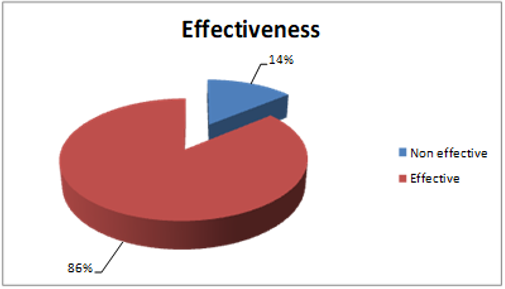
Figure 1: Effectiveness of directional movement technique procedure in low back pain Pain was centralized (improved) about 524 (86%) patients out of 609 patients by using directional movement technique and 14% patients was not improved that means decentralized.
The most usable technique was extension in lying (EIL). Among them 268(51%) patients was treated by this directional movement for centralization of pain. The second usable directional movement technique was flexion in lying (FIL). About 97(17%) patients were centralized by this technique after that orderly extension in standing (EIS) was 61(12%) patients, flexion in standing (FIS) 37(8%) patients, flexion in lying with rotation (FIL+Rot) was 24(5%) patients, saggital gliding in standing (SGIS) was 25(5%) patients and finally flexion in step standing (FISS) was 12(2%) patient.
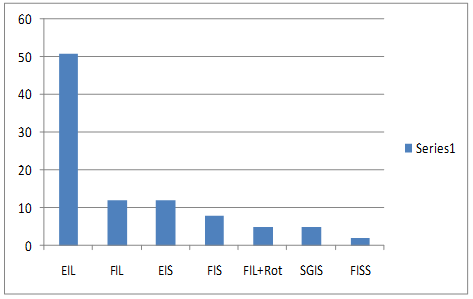
Figure 2: This bar chart has focused the percentage of effectiveness of individual directional movement technique procedure that was used for the treatment of low back pain.
This study focused different age group who were affected low back pain. Study found 36-40 years was most vulnerable for back pain. Individual are most susceptible to symptomatic disc injuries between the age of the 30-45 years. During this time, the nucleus is still capable of absorbed water, but the annulus fibrosus become weaken from fatigue loading overtime and, therefore, is less able to withstand increased pressure when they are disproportionately high stresses. The nuclear material may protrude into the tears of fissures, which most commonly are posterio-lateral and with increased pressure may bulk agonized the outer annular fibres, causing an annular distortion; or the nuclear may extrude from the disc through complete fissure in the annulus. It may cause this age group were involve vulnerable works. And other cause may be these age groups more come to the physiotherapy department for treatment of low back pain. The other groups may be did not give priority for treatment of low back pain. Age changes are commonly seen in the lumber spine on radiography, but the relationship between these structural changes and the symptom of back pain is not straight forward and theories based on a casual link between the two may have retarded research and treatment for back pain sufferers. They have had back pain in the last 12 months, the peak prevalence (about40%) will occur in the age group 45-54 years, with the number of females slightly more than the number of males. There is a reduction in prevalence either side of this decade, although a significant annular prevalence in children under 15 years of age does occur.11 Directional treatment technique procedure for low back pain based on according to McKenzie concept. Specially 7 directional movement techniques (EIL, FIL, EIS, FIS, FIL with Rotation, SGIS, FISS) were used for treating for low back pain. Among them most of the useable technique was extension in lying. Another study has shown McKenzie extension of spinal stabilizing exercise group attained significant improvement in a chronic low back pain.12 Although extension exercise have been associated with relief of low back pain. Patient who have an acute disc prolapsed have undergone multiple back operation, have limited flexion because of paraspinous scaring or have facet joint disease (Spinal stenosis) may have exacerbation of symptoms with extension exercises. Repeated extension motion of relieves the symptoms by managing the swollen tissue and moving the fluid to reverse the stasis.
Directional movement technique is most effective technique for treating mechanical low back pain (MLBP) patient. This technique has been applying in physiotherapy center for several years. Thousands of patients are treating this technique. But there is no any statistic about outcome to this treatment procedure at physiotherapy center. Directional movement technique is an international standard technique and it proves its effectiveness by various researches. This project studies may done for evaluation of the uses of this technique at physiotherapy centers. The result of this studies that this technique is completely run by McKenzie trained physiotherapist in physiotherapy center. These result will supports the other studies of the world.
Dear Editorial Team, Clinical Medical Reviews and Reports. My experience with the journal was highly positive. The peer-review process was rigorous, constructive, and completed in a timely manner. The reviewers provided valuable comments that helped improve the quality and clarity of our manuscript. The editorial office was professional, responsive, and supportive throughout all stages of the publication process. Communication was clear and efficient, and any questions were addressed promptly. Overall, I found the journal to maintain high scientific standards and an excellent publication workflow. I would be pleased to consider submitting future work to this journal. Best wishes from, Elena Popa.

It was my pleasure to submit my testimonial concerning the Reviewer Board of our Scientific Journal “Brain and Neurological Disorders”. The Reviewers focused on some modifications and their contribution was helpful. The ladies of our Editorial Office were also supported my efforts. It was my honor to have such a co-operation and I am looking forward for more collaboration.
Dear Grace Pierce, Editorial Coordinator of Journal of Clinical Research and Reports, Thank you for the speedy and efficient peer review process. I appreciate the fact that your peer reviewers do not take months to respond like with some other journals. I would also like to thank the editorial office for responding quickly to my questions. It is an excellent journal. I plan to submit more manuscripts in the future. Best wishes from, Robert W. McGee

Dear Grace Pierce, Editorial Coordinator of Journal of Clinical Research and Reports, Working with you and your team on our recent publication in JCRR has been a truly wonderful and enjoyable experience. The responses were prompt, and the reviewers were patient, constructive, and highly professional. One reviewer in particular gave me the feeling that a professor was carefully reading and commenting on my coursework, which was deeply touching. The entire process was straightforward and hassle‑free, with no tedious online forms to complete. I highly recommend this journal. Best wishes from, DR Aibing Rao, Head of R&D

I Appreciate the Opportunity to Share my Experience with the Journal of Clinical Research and Reports. The peer review process was timely and constructive, and the feedback provided helped improve the quality of our manuscript. The editorial office was professional, responsive, and supportive throughout the process, ensuring smooth communication and efficient handling of the submission. Overall, it was a positive experience collaborating with your team.

Dear Mercy Grace, Editorial Coordinator of Obstetrics Gynecology and Reproductive Sciences, We would like to express our gratitude for your help at all stages of publishing and editing the article. The editors of the magazine answer all the necessary questions and help at every stage. We will definitely continue to cooperate and publish other works in the Obstetrics Gynecology and Reproductive Sciences! Best wishes from, Alla Konstantinovna Politova,