AUCTORES
Globalize your Research

Research Article | DOI: https://doi.org/10.31579/2690-4861/995
1 Robert Bosch Hospital, Department of Pathology, 70341 Stuttgart, Germany.
2 Robert Bosch Hospital, Executive Chief Physician, 70341 Stuttgart, Germany.
3 Abu Ali Sina Hospital, 1702 Mazar-e-Sharif, Afghanistan.
4 iPath Telemedicine Network gemeinnützige GmbH, D-26603 Aurich, Germany
5 Firooz Medical Laboratory, 3001 Herat, Afghanistan.
6 Balkh Clinic, 1702 Mazar-e-Sharif, Afghanistan.
7 Institute of Pathology, University Hospital Basel, CH-4031 Basel, Switzerland.
8 St. Vinzenz Allgäu, Kirchenweg 15, 87459 Pfronten, Germany.
*Corresponding Author: Peter Fritz, Robert Bosch Hospital, Department of Pathology, 70341 Stuttgart, Germany.
Citation: Fritz P, Kleinhans A, Sediqi A, Raoufi R, Haroon F, (2025), Medical telediagnoses in countries with limited resources: Comparison of a general generative AI system with a clinical decision support system, International Journal of Clinical Case Reports and Reviews, 31(4); DOI:10.31579/2690-4861/995
Copyright: © 2025, Peter Fritz. This is an open-access article distributed under the terms of the Creative Commons Attribution License, which permits unrestricted use, distribution, and reproduction in any medium, provided the original author and source are credited.
Received: 05 November 2025 | Accepted: 24 November 2025 | Published: 02 December 2025
Keywords: telemedicine; telepathology; telecytology; artificial intelligence; ChatGPT; clinical decision support system
Background/Aim: Achieving correct clinical or morphological diagnoses in countries with limited resources is a major challenge due to the lack of methods such as immunohistochemistry, molecular biology, or imaging, as well as the lack of specialists. Artificial intelligence (AI), whether in the form of generative intelligence or clinical decision support systems, is a promising method for bridging the gap in diagnosis between developed countries and countries with limited resources. For this purpose, we used the general generative AI system ChatGPT and the specialized semantic net-based AI system Memem7 as medical diagnostic support systems to improve telemedicine diagnosis in a resource-limited country. Materials and methods: 102 randomly selected cases from 3 hospitals in northern Afghanistan were classified by up to 7 telemedicine experts. In 61 cases (59.8%), the experts provided a disease classification (target diagnosis). In the remaining 41 cases, the experts only provided a list of differential diagnoses. We investigated how often ChatGPT and Memem7 could predict the target diagnosis or provide a list of essential differential diagnoses. Results: In 36/61 (59.0%) and 47/61 (77.1%) cases, respectively, ChatGPT and Memem7 recognized the target diagnosis. In 88/102 (86.3%) (ChatGPT) and 93/102 (91.2%) (Memem7) cases, a helpful list of differential diagnoses was provided.
Conclusion: Both artificial intelligence (AI-)-based systems show promising results, either in confirming the target diagnosis or in providing a helpful list of differential diagnoses.
The use of artificial intelligence (AI) in medicine, especially in disease classification (diagnosis), is constantly increasing [1-2]. Before assessing or testing its usefulness, two situations had to be distinguished [3-6]: [1] AI is used to classify a disease entity by selecting one of a few possibilities (narrow task-specific AI). Its usefulness is well documented and proven by very good test performance. [2] AI has to choose between all possible disease entities for a given patient, as coded in SNOMED, ICD-10, ICD-11, and ICD-O [7-10]. This approach is covered by clinical decision support systems (CDSSs) [11] or, more recently, generative AI such as ChatGPT [3,12-15]. Both approaches can be applied to telemedicine.
Telemedicine is a rapidly growing field of medicine [16-20] with 2 interesting features that are not primarily related to telemedicine consultations: [1] images and string variables of telemedicine consultations can be used for further research, provided that ethical aspects are considered and fulfilled, and [2] telemedicine consultations solve one of the most outstanding problems in countries with limited resources: the lack of experts. Considering both areas of interest (AI and telemedicine practice in a country with limited resources), 2 methods can be used to improve the quality of medical diagnosis: [1] generative intelligence approaches using natural language models [12-14] and [2] clinical decision support systems [11].
ChatGPT is a virtual assistant based on large natural language models. This system’s potential to improve the quality of medical diagnosis needs to be evaluated, especially when used in resource-constrained countries, where the risk of uncontrolled use of ChatGPT is particularly high [12-15].
In contrast, CDSSs [11] have a longer history of clinical use. CDSSs provide the clinician with a ranked list of possible differential diagnoses (DDs), accompanied by information about the proposed DDs. Examples of CDSSs include Isabel, ADA, Google Bard, and Memem7 [21-24].
While both systems are well studied in developed countries, studies of their use in resource-limited countries are rare, especially when combined with telemedicine and AI methods.
Our feasibility study aimed to investigate how often a target diagnosis (suggested by human experts in a telemedicine consultation) could be predicted by both systems (ChatGPT and a CDSS).
We tested the hypothesis that both a CDSS and ChatGPT could recognize the target diagnoses generated by the experts and provide a list of additional possible DDs in medical cases in a resource-limited country. These analyses were conducted on 102 pseudonymized real-world cases.
Patients: Data from 102 patients treated for various symptoms and diseases (see Table 1 and Part IV of the Supplement for details) were uploaded to a telemedicine platform (iPath-Network; see Afghanistan Forum below) for disease classification. Cases were randomly selected from 3865 telemedicine consultations conducted from October 1, 2021, to May 31, 2023, in northern Afghanistan. No cases were excluded from the random selection. These telemedicine consultations and classifications were performed by 4 pathologists (GS, PF, CF, PD), one dermatologist (KA), one emergency physician (CF), and one surgeon (RR). Not all experts were present at each case. Cases were uploaded by 3 local Afghan physicians (RR, SA, HF). A brief description of the patient’s age (in years, not birthday) and sex was available, as well as a brief description of the symptoms. In all cases, one or more static images (IPEG format, 1-20 images/case) were available. Histological, cytological, macroscopic, dermatological, and radiological images were uploaded. Computed tomography (CT) and magnetic resonance imaging (MRI) images were uploaded as written reports or as a sequence of images (rare). All cases were documented on iPath-Network. The uploading institutions were 2 private laboratories (Firooz Medical Laboratory, Herat; Balk Hospital, Mazar-e-Sharif) and 1 district hospital (Ibn Sina Hospital, Mazar-e-Sharif). All telemedicine consultations were free of charge. Expert diagnoses were made just in time (less than 3 days), explaining why, in some cases, only 2 experts gave their classification. Each day, all cases were discussed between the attending physician (SA, HF, RR) and the first-line experts (GS, PD, PF, CF, RR, HF). If there was no consensus among the first-line experts, we consulted experts with particular experience in a medical subspecialty, e.g., in bone tumor diseases, hematology, neuropathology, skin pathology, or radiology. Therefore, 3 levels of medical classification of a case were used (see Examples 1 and 2 in the Appendix): [1] the diagnosis of the local doctor in charge of the patient, [2] human experts and their disease classification (level 2 or first line of telemedicine diagnosis), and [3] the opinion of experts in a medical subspecialty if the case required specialist knowledge (level 3 or second line of telemedicine diagnosis). Finally, each case was discussed and concluded with an expert diagnosis or a list of DDs provided by the experts. The exact procedure is described in a flowchart (Figure 1). We presented ChatGPT or Memem7 with the parameters (descriptors) given by the physicians (symptoms, descriptions of images related to microscopy, macroscopy, radiographs, CT, or MRI). All descriptors (parameters) mentioned in the case description were transformed into a Memem7 code (alphanumeric code). The transformation was done by one of the authors (PF; see also Example 1 or 2 in the Appendix). ChatGPT and Memem7 were given the semantic meaning of the Memem7 code. To start ChatGPT and Memem7, we used the same parameters defined for each case (symptoms, image description in the form of macroscopy, microscopy, or descriptions of X-rays, CT, or MRI). The images were transformed into descriptors (string variables) by one of the authors (PF). These descriptors were considered as objects with or without attributes and uploaded to ChatGPT or Memem7 (for examples, see Supplement Cases 1 and 2). For all participants (GP, consultants, Memem7, and ChatGPT), we used exactly the same information (as a string variable or as the sentence “patient has a” for ChatGPT) (see examples in Supplement Cases 1 and 2).The data output was given in string variables (also termed phemes in Memem7) with an unique alphanumeric code.
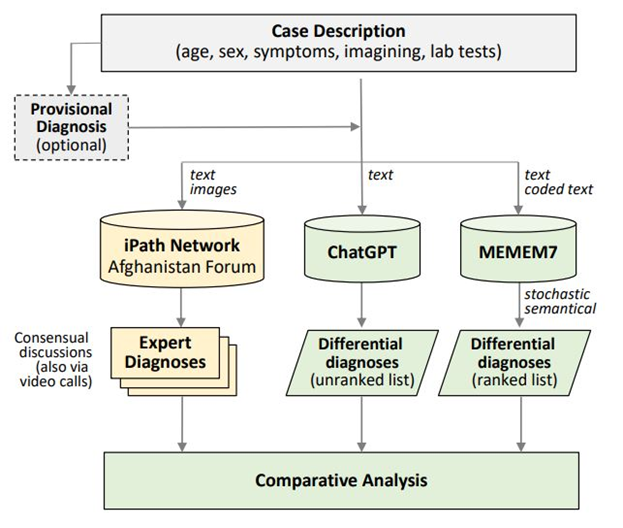
Figure 1: Flow chart of the study
Handling of images: Images (regardless of their structure) were transformed into a sequence of string variables. The macroscopic image of a skin tumor can be described as skin change: circumscribed; diameter: 2.5 cm; skin change: scaly.
Software system used:
iPath-Network: iPath-Network is a platform for telemedicine (originally telepathology) [25-29]. iPath-Network has been operational since 2010 and has processed more than 100,000 real-world cases [28], including the Afghanistan Forum, which has more than 20,000 consultations. The 102 study cases were randomly selected from the Afghanistan Forum, which is moderated by one of the authors (RR). Therefore, simple cases with a dermatological picture as well as extremely complex and difficult cases are part of the study. As all local examinations must be paid for by the patient and many special examinations required by international guidelines are not possible in northern Afghanistan, incomplete medical reports of our cases are common. All telemedicine diagnoses and consultations are free of charge. Immunohistochemistry or molecular biology tests were not available in northern Afghanistan.
Memem7: This is a non-commercial CDSS (computer-aided clinical decision support system) developed by 2 of the authors (KA, PF) [21]. It is based on a large semantic network (over 600,000 nodes) that is transparent to the user and contains all types of entities and relationships, such as objects, classes, parts, attributes, processes, states, properties, etc. The inference algorithms use the processing of the semantic network based on linguistic logic, which includes ambiguity, vagueness, and uncertainty. In any case, a search function can be used based on the terms entered. The input is mainly structured, but unstructured narrative input (e.g., medical reports) is also possible, which is processed by modified NLP (neuro-linguistic programming) algorithms. The result is an output with an ordered list of DDs of unlimited length. For each diagnosis, Memem7 provides a relevance value indicating the relevance of the search terms to the suggested diagnosis. Memem7 uses Bayesian methods to generate the list of diagnoses, i.e., the more terms that match leading symptoms, the higher the relevance score. Each natural language element (such as headache) is coded in Memem7 (headache = HC11|). This code is related to the ICD-10 and ICD-O codes and is part of a semantic up-and-down tree. In our example, there are 2 up-tree codes like head (A110) and pain (EP) and 38 down-tree codes like thunderclap headache (34673Z).
ChatGPT: ChatGPT is a recently developed generative AI system developed and maintained by OpenAI Inc. in Delaware. It is freely available [8-11,30]. We used ChatGPT version 3.5, which can be used via a natural-language text dialogue. We presented the list of symptoms to ChatGPT and asked for possible diseases. Images (either microscopic, macroscopic, ultrasound, or X-ray images) were transformed into string variables (see example in the Supplement).
Statistical methods: All data were part of the iPath-Network 2.0 documentation and are available to anyone registered with iPath-Network. Data were extracted from iPath-Network into an Excel spreadsheet (see Supplement). Statistical analysis was performed using R (version 4.3) [27]. p-values < 0.05 were considered significant. For the analysis of the 3 groups (experts vs. ChatGPT and Memem7), we used R’s aov method and the pairwise listed t-test [31,32]. A target diagnosis was classified as recognized by either ChatGPT or Memem7 if it was mentioned in the list of DDs. In addition, the list of DDs was classified as helpful or not by 2 of the authors (PF, CF) if the proposed disease entities fit the patient’s symptoms. The target diagnosis (correct or consensus diagnosis of the human experts) was defined as the disease entity used to guide further treatment decisions. The target diagnosis (consensus diagnosis of the human experts) was considered the gold standard, but not the ground truth. The ground truth remains unknown, especially when medical work is done in countries with limited resources. For data evaluation, we distinguished 2 situations: [1] the human experts provide a clear target diagnosis, and [2] the human experts provide only a list of DDs. In Situation 1, AI-proposed diagnoses were considered successful if the target diagnosis was mentioned in the proposed list of DDs. In Situation 2, AI diagnoses were considered helpful if the AI’s list of DDs contained clinical diagnoses of interest.
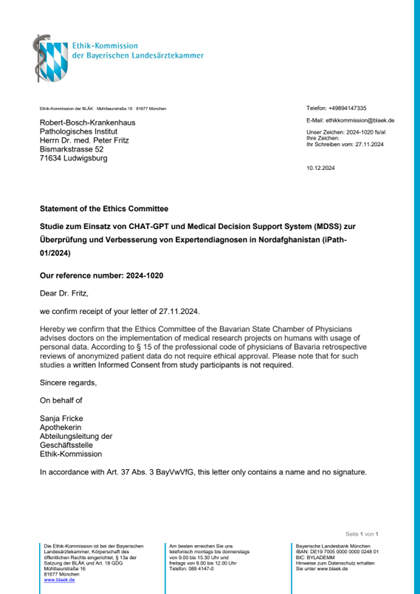
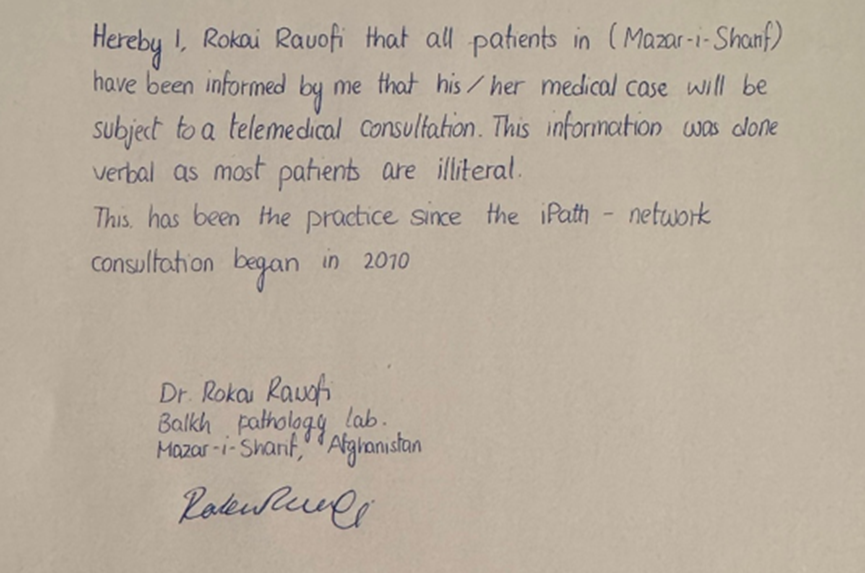
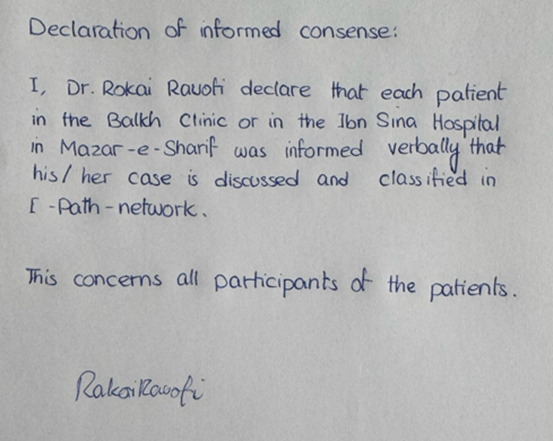
Ethics votum: It was difficult to fulfill all ethical aspects [33-34] under the given conditions of the presented study, as the patient data originated from Afghanistan and the data analysis took place in Germany. All patients were asked to agree to a telemedicine consultation with their treating physicians (AS, HF, RR). Neither name nor date of birth was available (pseudonymized data). Ethical approval (Ärztekammer 27.022024, Aktenzeichen 1020/2024: see Supplement) for the retrospective use of pseudonymized data from Afghanistan is available. Patients were only included if they had given verbal consent to the treating physician (AS, HF, RR). Most patients were unable to provide written consent due to local conditions and, more importantly, the high prevalence of illiteracy. Therefore, some protection standards of developed countries [29-30] could not be applied in the daily working conditions of northern Afghanistan. All participants of the study gave informed (verbal) consent and were informed by the physicians locally in charge that their case would be classified in a telemedical platform (iPath-Network) and the anonymized data would be used for research. The declarations of the physicians in charge (Dr. Rokai Raoufi and Dr. Atiq Sediqi) are reported in the Supplement, like the ethics votum.
The most common diagnoses in our study were dermatological, oncological, gynecological, gastroenterological, and head and neck diseases (see Table 1 and Supplement Part IV). The patients’ mean age was 34 years (SD = 22.1), with a slight female preponderance. The human experts (PD, GS, PF, HF, RR, CF) were able to suggest a target diagnosis in 61 (59.8%) of the 102 study patients. In the remaining cases, DDs were provided, leaving the decision to the local physician in charge. In up to 34/102 cases (33.3%), a third opinion was sought from highly qualified and specialized experts in hematology, lymph node classification, or bone and neurological diseases (GO, GJ, Tzankov A, Feiden W). For each case, either a disease classification or a list of DDs was available. The characteristics of the study patients and the allocation of the study cases to the individual medical specialties are shown in Tables 1 and 2.
The expert diagnosis was made by up to 7 experts. On average, 6.3 medical terms (descriptors, string variables such as fever) were provided for disease classification (see Table 1). On average, 14 images per case were used for classification (Table 2).
The most common image types were microscopic, followed by macroscopic and radiological (radiographs, ultrasound, CT, or MRI). Laboratory data are rarely included, except in hematological cases. CT or MRI images were uploaded as written reports. All images were transformed into string variables as shown in Examples 1 and 2 (Supplement). These string variables were uploaded in Memem7 or as a verbal description (“patient has a”) in ChatGPT. String variables were added, such as fever; headache; tumor cells: large; or lung mass: lower lung field: right side. This was considered as a vector of string variables [27], as defined in R.
Of the 61 cases with a clear human expert diagnosis (target diagnosis), 36 (59.0%) were recognized by ChatGPT and 47 (77.1%) by Memem7. Either ChatGPT or Memem7 or both recognized the target diagnosis in 51 cases (83.6%). The difference between human experts and Memem7 was not significant, nor was the difference between ChatGPT and Memem7 (p = 0.55).
The number of DDs identified by human experts was 1.4 (approximately only 1 DD per case), compared to 5.3 and 5.4 by ChatGPT and Memem7, respectively (see Figure 2). This difference was highly significant (p < 0.00001 in ANOVA). In 88/102 (ChatGPT) or 93/102 (Memem7) of the study cases, a helpful DD list was provided. The DDs suggested by ChatGPT or Memem7 were found to be helpful in (1) finding very rare diseases, (2) confirming one’s own opinion, and (3) extending the list of DDs. Both AI systems performed equally well but generated significantly more DDs than human experts (p < 0.00001).
| Patients | N = 102 | Commentary |
gender male female missing values |
42 42.9% 57.1 57.1% 4 | Weak dominance of females Not significant, p:031 |
Age (years) mean SD median |
34.0 22.1 35 |
Wide distribution of patients’ age |
| Number of primary descriptors | String variables/case Objects (symptoms) with or without attributes | |
mean SD | 6.3 2.1 | |
| median | 6 | |
| Number of experts involved |
On average, 4 experts assisted with each videoconference | |
| mean | 4.6 | |
| SD | 2.2 | |
| median | 4 | |
| Images presented/case | Most presented images are histology | |
| mean | 14.0 | |
| SD | 9.8 | |
| median | 10 | |
| range | 1-45 | |
| Macroscopic images (mean) | 1.4 | 1-2 macroscopic images In about every second case, an X-ray is available |
| Cases with radiograms (mean) | 0.4 |
Table 1: Features of the study patients
Medical disciplines N = 102 patients 140 assignments | N = 102 | % |
| Gastroenterology | 9 | 18.6 |
| Gynecology | 17 | 12.1 |
| Hematology | 3 | 2.1 |
| HNO (head, ear, neck, nose) | 13 | 9.3 |
| Infectiology | 5 | 3.5 |
| Oncology | 29 | 20.7 |
| Orthopedics | 12 | 8.6 |
| Pediatric disease | 13 | 9.3 |
| Pulmonology | 2 | 1.4 |
| Dermatology | 25 | 17,6 |
| Urology | 6 | 4.2 |
| Ophthalmology | 4 | 2.8 |
| Autoimmune disease | 1 | 0.7 |
| Neurology | 1 | 0.7 |
| Endocrinology | 1 | 0.7 |
Table 2: Medical specialties. More than one assignment per case was possible.
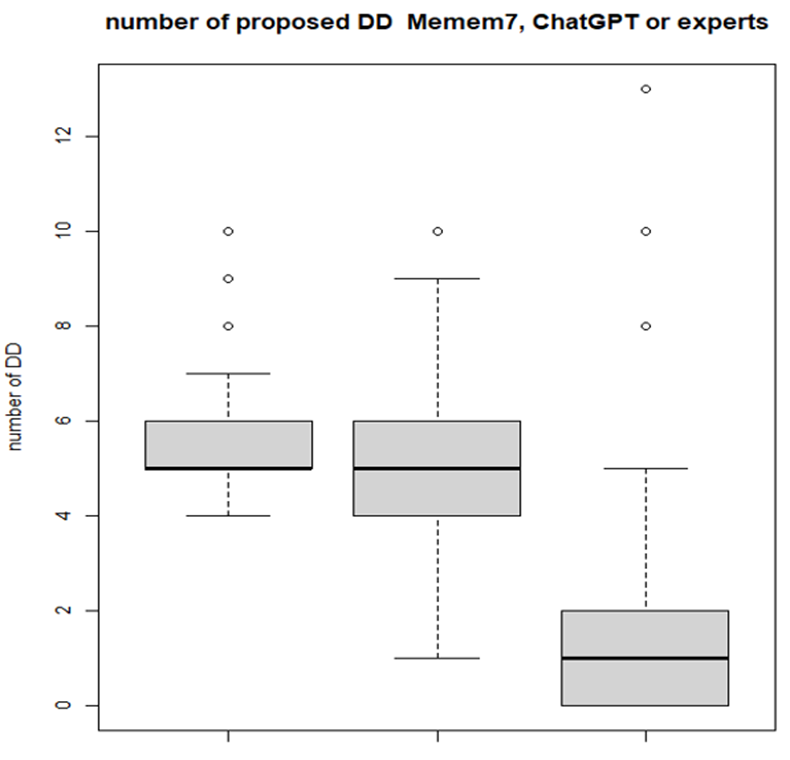
Figure 2: Comparison between the number of DDs provided by either ChatGPT, Memem7, or the human experts.
We present data showing that both generative AI in the form of ChatGPT and a CDSS in the form of Memem7 significantly improved the diagnostic quality of human experts by expanding the list of DDs and confirming the experts’ diagnosis in a high percentage of cases.
AI is expected to become increasingly important in medicine and telemedicine in the near future [35,36]. The bottleneck is how to prove the usefulness of AI in medical decision-making [37-40]. Two fundamentally different test situations need to be considered:
(1) Test Situation 1 (narrow task-specific AI). In this situation, the AI assistance has to choose between a small number of possible goals (arbitrarily n < 10). This situation exists, for example, when wearable AI is used to detect early heart failure [35]. When testing AI in this setting, high reliability, measured as sensitivity, accuracy, or area under the curve, can be expected (up to 97.1% sensitivity) [35, 36]. The number of possible decisions (disease entities to be found by the AI) below which the AI shows very high accuracy values (>90%) has not been investigated and is therefore arbitrary.
(2) Test Situation 2 (a holistic approach, i.e., including all possible diagnoses in the AI analysis). In this test situation, all possible diagnoses reported in medical ontologies, such as IC-10, ICD-11, or SNOMED, must be considered. ChatGPT and AI-based medical decision support systems generate a list of possible DDs based on probability from a pool of >10,000 possible diseases. In this situation, the test results’ accuracy ranges between 58.2% and 82% (for a review, see Turcian et al. [35]). In Memem7 [21], for example, 17,422 diseases are reported. In ICD-10 [3], symptoms and diseases are mixed, but the number of coded disease entities is >20,000.
The holistic approach is difficult to test. The accuracy and test performance of the AI methods mentioned in Test Situation 1 (with few possible decisions) clearly cannot be expected in Test Situation 2 of medical decision support systems (with a holistic diagnostic approach). The classical CDSSs, such as Isabel, Ada, and Memem7 [21-25], have recently faced comparisons with generative AI systems such as ChatGPT [12-15]. In our 102 study patients, both Memem7 and ChatGPT show comparable results. However, Memem7 was also able to provide a ranked list of DDs (see the output of ChatGPT and Memem7 in Test Cases 1 and 2 in the Supplement), while ChatGPT only generated a list of unranked DDs. Although the number of DDs suggested by ChatGPT was significantly higher than that given by the human experts, no probability ranking was given to help decide in favor of a particular diagnosis.
In countries with limited resources, the situation is very complicated. Many diagnoses listed in ICD-10, ICD-11, or SNOMED [7-10] cannot be provided due to a lack of information or a lack of appropriate tests. Despite these limitations, a treatment decision must be made (if possible, in the local context as near as possible to the international standards). Working in countries with limited resources can be considered a modified Test Situation 2 with a high frequency of missing information.
One of the main advantages of generative AI, such as ChatGPT or Memem7, is its excellent human-like multilingual conversation, which does not require additional input/output support. Codes such as ICD-10, ICD-11, or ICD-O [7-10] are available in different languages, including Arabic [4].
An exciting and medically successful application of CDSSs and ChatGPT is the use of these systems in countries with limited resources. We have long experience using Memem7 and Isabel in northern Afghanistan [25-29]. In this publication, we present approximately 100 randomly selected real-world cases where expert diagnoses were compared with the results of using ChatGPT and Memem7. The results are as follows: (1) In 59.9% of cases with known target diagnoses, ChatGPT recognizes the target diagnosis, and Memem7 mentions the target diagnosis in 77.1% of cases; (2) in most cases, both systems provide a list of helpful DDs (about 86.3% for ChatGPT and 91.2% for Memem7); and (3) the number of DDs proposed by both systems was comparable and significantly exceeded the number of DDs provided by the human experts. We believe that both systems provide a meaningful and useful list of DDs when used to improve the quality of disease classification in low-income countries.
One problem with using AI in a holistic approach is that many different types of images are provided. Currently, verbal descriptors (string variables) have to be generated for all images, which must be transformed into string variables by doctors or paramedical staff (see Example Cases 1 and 2 in the Supplement). In Test Situation 1, image classification has been used very successfully in radiology [41,42] and increasingly in pathology [43]. We have developed an algorithm to classify breast fine-needle aspiration cytology images as benign or malignant (only 2 possible decisions) with an accuracy of 78.4% [44]. Image classification in Test Situation 2 (many target diagnoses to be recognized) is, to the best of the authors’ knowledge, not yet possible.
The great promise of CDSSs and the use of ChatGPT as exemplified in our study are (1) its use in countries with limited resources; (2) the fact that the attention of non-specialists is drawn to rare diseases; (3) an educational impact, E.g. the local physician is confronted with the human experts (see point 3) and acquire substantial new knowledge available for him in Memem7; (4) its use in an n > 10 classification problem (holistic approach); and (5) the provision of a list of ranked DDs in unclear medical cases.
The disadvantages of the proposed approach to telemedicine diagnosis are as follows: (1) We are dealing with black box systems. We do not know the AI systems’ arguments for proposing an unambiguous diagnosis. This is especially true for ChatGPT. (2) The doctors in charge are forced to do additional work with each proposed DD. They are often forced to rule out a DD that was not previously considered for the patient, but is now suggested by the CDSS. AI systems based on ChatGPT used in Test Situation 2 have additional disadvantages. Generative AI systems show a tendency to hallucinate in further dialogue [13]. Moreover, they still lack the ability to represent the details of information sources and the decision logic of their results [12,13], whereas semantic net-based AI systems can already do this. They provide access to the entire chain of reasoning and the information on which it is based. They also allow additional detailed analysis of symptoms and DDs based on their universal semantic logic and provide a list of ranked DDs. Human control is better in CDSSs than in ChatGPT, and all learning effects are easier to follow in CDSSs than in ChatGPT.
What future developments are needed for both approaches (ChatGPT and CDSSs) before we can use one or both methods in daily practice in countries with limited resources? (1) Improved opportunities for human-machine interaction, (2) an urgent need for better and stable Internet platforms such as iPath-Network that minimize the workload of local doctors or experts involved in telemedicine, (3) an urgent need for high-quality studies to measure quality improvement through the use of AI systems in telemedicine, (4) better control of the proposed output, and (5) the possibility of structured analysis in ChatGPT.
We report on the use of either ChatGPT or a CDSS to improve the quality of diagnosis in a country with limited resources, at the level of either predicting the expert diagnosis (with moderate sensitivity) or providing a helpful list of DDs (with high sensitivity). Considering the present study and its promise, a larger multicenter study should be planned to evaluate CDSSs in developing countries.
Approval by the Ethics Commission of the Bayerische Ärztekammer 27.022024, Aktenzeichen 1020/2024: All patients were asked to agree to a telemedicine consultation with their treating physicians (AS, HF, RR). Neither name nor date of birth was available (pseudonymized data). Patients were only included if they had given verbal consent to the treating physician (AS, HF, RR). Most patients were unable to provide written consent due to local conditions and, more importantly, the high prevalence of illiteracy. The abovementioned ethical approval confirmed that for our study, written consent was not necessary. Our study is in compliance with the Helsinki Declaration.
Consent for publication:
All coauthors are informed and agree to the publication.
Availability of data and material:
All data are available in iPath-Network for members of iPath-Network’s Afghanistan Forum. Any physician or scientist may become a member of iPath by registering at iPath-Network.com.
Competing interests:
None of the authors declares a conflict of interest.
Funding:
No funding.
Authors’ contributions:
Fritz P: manuscript preparation, expert diagnosis, statistics, algorithm for Memem7
Kleinhans A: manuscript preparation, algorithms for Memem7 and ChatGPT
Sediqi A: case upload, primary diagnosis
Raoufi R: case upload, primary diagnosis, expert diagnosis
Haroon F: case upload, primary diagnosis
Alaboud K: third opinion in all dermatological cases, study design
Fritz-Kuisle C: manuscript preparation, evaluation of Memem7 and ChatGPT diagnoses
Dalquen P: expert diagnosis, third opinion in all cytological cases, manuscript preparation
Jundt G: third opinion in all cases with bone diseases, manuscript preparation
Ott G: third opinion in all cases with lymphoproliferative diseases
Stauch G: expert diagnosis, study design, manuscript preparation
Alscher MD: manuscript preparation
Acknowledgments: We thank the Evangelische Kirchengemeinde Aurich for financial support and Prof. W. Feiden and Prof. A. Tzankov for skilled diagnoses in neuropathology and hematopathology.
Authors’ information:
Not applicable.
Example case 1: (Afghanistan forum , iPath-network).
Ipath id: 1380272; Memem/ casuosom 6857
Input as string variables: 25 years, male, lung collapse right, lymphocytic serositis, pleural effusion.
Note that German and English language are interchangeable as one Memem7 code relates to the German and English meaning
Expert classification: Pleuritis tuberculosa
Memem 7 output: (semantic, stochastic search and similar case search)
A16.5 Pleuritis tuberculosa 1353X| 06-73 C42.1
Multiples Myelom M0801| 04-91
N00.8 Akute interstitielle Nephritis M5707|
04-63 N71.1 Chronische Endometritis M3486|
03-82 J84.1 Interstitielle Lungenerkrankung M0933|
03-79 I88.9 Lymphadenitis colli M1031| 03-73 J44.99
Chronisch-obstruktive Lungenkrankheit M0061| 03-72
Chat-GPT output:
ChatGPT: J90 Pleuraerguß M2068|, J98.1 Lungenatelektase 39737X|, A15-A19 Tuberkulose M0770|, C34.9 Lungenkrebs M0314|, D86.- Sarkoidose M0816|, J18.9 Pneumonie M0784|, D89.9 Autoimmunerkrankung
M2695|
Memem7 and Chat -GPT output (proposals of DD) recognised the target diagnosis and provided some meaningful DD.
Some results as chronic endometritis or acute interstitial nephritis in Memem7 or Autoimmunerkrankung in ChatGPT
were considered as not helpful
Example case 2: (Afghanistan forum , iPath-network).
IpATH ID. : ipath id, 1459368h, memem7: casusom6858
Input as string variables: 55 year, female., ovar, tumor cells: middle seized, hemorrhagia, cell nuclei: cleaved.
Note that German and English language are interchangeable (see example 1
Expert classification: Granulosa cell tumor
Memem7 output:
| D76.08 | Langerhans Histiozytose des Knochens 77545X| | 07-72 | |||||||
| C96.0 | Langerhans-Zell-Histiozytose M1193| | 07-72 | |||||||
| Dysgerminom 90603N| | 06-74 | ||||||||
| C41.9 | Leiomyosarkom des Knochens M2946| | 05-75 | |||||||
| C49.9 | Mesenchymales Chondrosarkom 92403N| | 05-75 | |||||||
| C84.4 | extranodal NK/T-cell lymphoma M8991| | 05-71 |
Chat-GPT output:
ChatGPT: C56 Eierstockkrebs 213500R|, C56 Ovarialkarzinom M1172|, C80 Metastasen UT62|, D39.1 Ovarialtumor M2038|, N80.- Endometriose M0487|, N70.9 Ovarialabszess 52834X|
Both results (Memem7 and Chat_GPT) were considered as not very helpful. The Memem7 results failed to recognize granulosa cell tumor and provided only very rare DD. In addition two diagnosis with false localization were given. The Chat-GPT answer provided only very general list of DD and did not recognize the target diagnosis as well.
List of diagnosis used in the presented study
CG_1:102
| ID-identificator | Target diagosis | diagnosis | ICD-10 | ICD-0 | C-classification | CG_Nummer |
| 1292247 | yes | dermatofibroma | D23.9 | 8832/0 | C44 | CG_001 |
| 1292661 | yes | granuloma pyogenicum | L98.8 | Not def | C44 | CG_002 |
| 1293371 | yes | Squamous cell carcinoma ear | C44.9 | 8070/3 | C44.2 | CG_003 |
| 1312268 | no | DD | list of DD | List of DD | C41 | CG_004 |
| 1312889 | yes | cutaneous leishmaniosis | B55.1 | Not def | C44 | CG_005 |
| 1321185 | no | DD | list of DD | list of DD | C44.3 | CG_005 |
| 1323877 | yes | cutaneous leishmaniosis | B55.1 | Not def | C44 | CG_006 |
| 1329270 | no | DD | list of DD | list of DD | C07 | CG_007 |
| 1329670 | no | DD | list of DD | list of DD | C11.9 | CG_008 |
| 1333142 | yes | inverted follicular keratosis | L11.0 | Not def | C44 | CG_009 |
| 1337651 | no | DD | list of DD | list of DD | C44 | CG_010 |
| 1341844 | no | DD | list of DD | list of DD | C44 | CG_011 |
| 1341960 | yes | psoriasis | L40.0 | Not def | C44 | CG_012 |
| 1347696 | yes | nummular excema | L30.3 | Not def | C44 | CG_013 |
| 1352051 | no | DD | list of DD | list of DD | C44 | CG_014 |
| 1360374 | no | DD | list of DD | list of DD | C44 | CG_015 |
| 1372153 | yes | serous carcinoma of ovar, high grade | C56 | 8461/3 | C56 | CG_016 |
| 1380477 | no | DD | list of DD | list of DD | C40 | CG_017 |
| 1382272 | no | DD | list of DD | list of DD | C38.4 | CG_018 |
| 1382565 | no | DD | list of DD | list of DD | C44 | CG_019 |
| 1386174 | no | DD- | list of DD | list of DD | C44.6 | CG_020 |
| 1386796 | no | DD | list of DD | list of DD | C10 | CG_021 |
| 1387420 | no | DD | list of DD | list of DD | C44.6 | CG_022 |
| 1388771 | no | DD | list of DD | list of DD | C69.6 | CG_023 |
| 1389210 | no | DD | list of DD | list of DD | C69.9 | CG_024 |
| 1389592 | no | DD | list of DD | list of DD | C54.9 | CG_025 |
| 1389701 | no | DD | list of DD | list of DD | C44.5 | CG_026 |
| 1390824 | yes | mastitis | N61 | not def | C50 | CG_027 |
| 1390967 | no | DD | list of DD | list of DD | C69.8 | CG_028 |
| 1391528 | yes | chronic osteomyelitis | M86.69 | not def | C41 | CG_029 |
| 1392057 | yes | fibroma-like lipoma | D17.9 | 8850/0 | C49 | CG_030 |
| 1392064 | yes | fibrocystic disease of breast | N60.1 | not def | C51 | CG_031 |
| 1392378 | yes | Non-Hodgkin lymphoma | C83.- | 9591/3 | C77.9 | CG_032 |
| 1392752 | yes | lymph node metastasis | C77.9 | 8000/6 | C77.9 | CG_033 |
| 1393244 | yes | squamous cell carcinoma of esophagus | C15.- | 8070/3 | C15.9 | CG_034 |
| 1393520 | yes | serous cystadenoma of testis | D36.9 | 8441/0 | C62 | CG_035 |
| 1393567 | yes | Prostatic adenocarcinoma | C61 | 8140/3 | C61 | CG_036 |
| 1393867 | yes | luteinized follicle cyst of ovary | N83.0 | Not def | C56 | CG_037 |
| 1394504 | yes | squamous cell carcinoma oral cavity | C44.9 | 8070/3 | C10 | CG_038 |
| 1394516 | yes | squamous cell carcinoma esophagus | C44.9 | 8070/3 | C15.9 | CG_039 |
| 1394527 | no | DD | list of DD | list of DD | C44.5 | CG_040 |
| 1394648 | no | DD | list of DD | list of DD | C44.4 | CG_041 |
| 1394665 | yes | PUPPP* | O26.8 | Not def | C44.9 | CG_042 |
| 1394903 | yes | Fibroadenoma of breast | D24.- | 9010/0 | C50.9 | CG_043 |
| 1395149 | no | DD | list of DD | list of DD | C49.9 | CG_044 |
| 1395256 | yes | Solitary fibrous tumour of pleura | D48.1 | 8815/0 | C38.4 | CG_045 |
| 1396364 | yes | esophageal adenocarcinoma | C15.- | 8140/3 | C15.9 | CG_046 |
| 1396387 | yes | Malignant myoepithelioma forearm | ot def | 8982/3 | C54 | CG_047 |
| 1396639 | no | DD | list of DD | list of DD | C44.7 | CG_048 |
| 1397019 | yes | villous adenoma low grade bowel | D37.5 | 8263/0 | C18.8 | CG_050 |
| 1401487 | yes | thyreoglossal cyst | K09.8 | N81.4 | C73 | CG_051 |
| 1401545 | yes | nodular lymphocytic dominant HL | C81.1 | C81.4 | C77.9 | CG_052 |
| 1403160 | yes | myoglandular hyperplasia prostata | N40 | not def | C61.9 | CG_053 |
| 1405929 | yes | papillary thyroid carcinoma | C73 | 8260/3 | C73 | CG_054 |
| 1407827 | no | DD | list of DD | list of DD | C41.9 | CG_055 |
| 1408883 | no | DD | list of DD | list of DD | C44.3 | CG_056 |
| 1409518 | yes | spindle cell lipoma | D17.9 | 8857/0 | C49 | CG_057 |
| 1409902 | yes | reparative bone granuloma | K10.1 | Not def | C41 | CG_058 |
| 1410388 | yes | Pneumonia | J18.9 | Not def | C34 | CG_059 |
| 1410408 | yes | Pleomorphic adenoma salivary gland | D11.0 | 8940/0 | C07 | CG_060 |
| 1410840 | yes | Esophageal squamous cell carcinoma | C44.9 | 8070/3 | C15.9 | CG_061 |
| 1411720 | yes | Ewing sarcoma humerus | C41.9 | 9260/3 | C40.0 | CG_062 |
| 1412331 | yes | neurinoma | D36.1 | 9560/0 | C47.9 | CG_063 |
| 1412885 | yes | hyperkeratosis plantaris et palmaris | L85.1 | Not def | C44 | CG_064 |
| 1413600 | yes | osteomyelitis | M86.- | Not def | C41 | CG_065 |
| 1414127 | no | DD | list of DD | list of DD | C49 | CG_066 |
| 1418796 | yes | neurinoma | D36.1 | 9560/0 | C47.9 | CG_067 |
| 1419100 | yes | large cell lung carcinoma | C34.9 | 8012/3 | C34 | CG_068 |
| 1420265 | yes | angiofibroma vagina | D21.9 | 9160/0 | C52 | CG_069 |
| 1420656 | yes | low grade NHL | C85.9 | 9590/3 | C77 | CG_070 |
| 1421984 | yes | granuloma pyogenicum | L98.8 | Not def | C44 | CG_071 |
| 1422784 | no | DD | list of DD | list of DD | C42.1 | CG_072 |
| 1426750 | yes | breast cancer | C50.9 | 8500/3 | C51 | CG_073 |
| 1427771 | no | DD | list of DD | list of DD | C70 | CG_074 |
| 1428269 | yes | simple bone cyst | M85.69 | dot def | C41 | CG_075 |
| 1428582 | no | DD | list of DD | list of DD | C44.7 | CG_076 |
| 1429732 | yes | MALT lymphoma | C85.7 | 9699/3 | C77.9 | CG_077 |
| 1430194 | yes | squamous cell carcinoma esophagus | C44.9 | 8070/3 | C15.9 | CG_078 |
| 1430478 | yes | Wilms Tumor | C64 | 8960/3 | C64 | CG_079 |
| 1431229 | yes | acute mastitis | N61 | Not def | C50.9 | CG_080 |
| 1431818 | yes | squamous cell carcinoma lingula | C44.9 | 8070/3 | C10 | CG_081 |
| 1431889 | no | DD | list of DD | list of DD | C42.1 | CG_082 |
| 1434581 | no | DD | list of DD | list of DD | C77.9 | CG_083 |
| 1436380 | yes | breast carcinoma | C50.9 | 8070/3 | C51 | CG_084 |
| 1437649 | no | DD | list of DD | list of DD | C73 | CG_085 |
| 1438752 | no | DD | list of DD | list of DD | C54 | CG_086 |
| 1440675 | yes | osteochondroma | D16.9 | 9210/0 | C41 | CG_087 |
| 1440823 | yes | PUPPP* | O26.8 | Not def | C44 | CG_088 |
| 1441292 | yes | soor glossitis | B37.0 | Not def | C10 | CG_089 |
| 1442416 | yes | atypical uterine leiomyoma | D21.9 | 8893/0 | C54 | CG_090 |
| 1442921 | no | DD | list of DD | list of DD | C56 | CG_091 |
| 1445614 | yes | verruca vulgaris | B07 | Not def | C44 | CG_092 |
| 1445772 | no | DD | list of DD | list of DD | C44 | CG_093 |
| 1447409 | no | DD | list of DD | list of DD | C62 | CG_094 |
| 1448905 | yes | torsion of testis | N44.0 | Not def | C62 | CG_095 |
| 1452894 | no | DD | list of DD | list of DD | C77.0 | CG_096 |
| 1460304 | no | DD | list of DD | list of DD | C77.9 | CG_097 |
| 1460095 | no | DD | list of DD | list of DD | C77.9 | CG_098 |
| 1459899 | yes | verruca vulgaris | B07 | Not def | C44 | CG_099 |
| 1459638 | no | DD | list of DD | list of DD | C62 | CG-100 |
| 1460230 | yes | epidermoid cyst | L72.0 | Not def | C15.9 | CG_101 |
| 1462165 | yes | Verruca-vulgaris | B07 | 8050/0 | C44.6 | CG_102 |
Pruritic urticarial papule and plaques of pregnancy. Note that the last two rows gave a clear code for each target diagnosis ( in up to 40 languages) and a distinct discrimination of a given diagnosis. Not def= not defined in ICD-O. list of DD= means that a long list of ICD-10 classifications, ICD-O classifications and C-Code is present. The last row signifies the documented results in Memem7.
Dr.Fritz Peter, 71634 Ludwigsburg, Bismarkstrasse 52 Germany phone: .00491634701683 E-MailPeter.Fritz23@arcor.de
• Dr.Kleinhans Andreas, 70188 Stuttgart, Am Hohengehren 8phone: 00491777260765, E-Mail:andreas.kleinhans@fuchspartner.de
• Dr. Raoufi Rokai, Balkh pathology laboratory.Karte shafakhana St.3 Mazar-i-sharif ( 1702 ) Afghanistan. Present address: Kaiser Maxstr. 38 Kaufbeuren, phone: 0049 1733227948, E-Mail: Rauofi Rokai
• Prof. Dalquen Peter, Institute of Pathology University Basel CH-4031 Basel, Switzerland.E-Mail: Peter Dalquen dalquen@sunrise.ch>
• Dr. Sediqi Atiq, Balkh pathology laboratory And Abu Ali Sina Hospital.Mazar-i-sharif, Afghanistan.Phone: 0093706441817 E-Mail: atiq.sediqi@outlook.com>
• Dr. Firooz Haroon, Medical laboratory 3001 Herat Afghanistan.E-Mail: haroon firooz
• Dr. Stauch Gerhard, 26605 Aurich Parkstr. 62, Germany, phone; 99494187590 E-Mail: gerhardstauch@web.de
• Prof. Dominik Alscher, Robert Bosch Hospital Stuttgart, Germany E-Mail: dominik.alscher@rbk.de
• Dr.Fritz-Kuisle Christine, St. Vinzenz Allgäu (Klinik/MVZ/Reha)., Germany, E-Mail: christine-fritz@web.de
• Prof. Ott German, Department of Pathology, Robert Bosch Hospital Stuttgart, Germany German.E-Mail:German.Ott@rbk.de
• Prof Jundt Gernot, Department of Pathology, University Hospital Basel, Switzerland E-Mail: gernot.jundt@me.com
• Prof. Alaboud Khalid, Department of Dermatology Mekka, Saudi Arabia, phone 00966503709099, Email: alaboudkhalid@yahoo.ca
Authors contribution to the manuscript
Fritz P1: manuscript preparation, expert diagnosis, statistic, algorihmus for Memem7leinhans A4,: mamuscript preparation, algorihmus for Memem7, Chat-GPT
Sediqi A3,7: case upload, primary diagnosis
Raoufi R3,7: case upload, primary diagnosis, expert diagnosis
Haroon F5: case upload, primary diagnosis
Alaboud K3: third opinion in all dermatological cases, study design
Fritz-Kuisle C3 manuscript preparation evaluation of Memem7 and Chat-GPT diagnoses
Dalquen P3,8: expert diagnosis, third opinion in all cytological cases, manuscript preparation
Jundt3,8: third opinion in all cases with bone diseases, manuscript preparation
Ott G1 : third opinion in all cases with lymphoproliferative diseases
Stauch G3: expert diagnosis, study design, manuscript preparation
Alscher MD2: manuscript preparation
Ethic votum:
Approval by the ethic Comittee of the Bayerische Ärztekammer 27.022024, Aktenzeichen 1020/2024
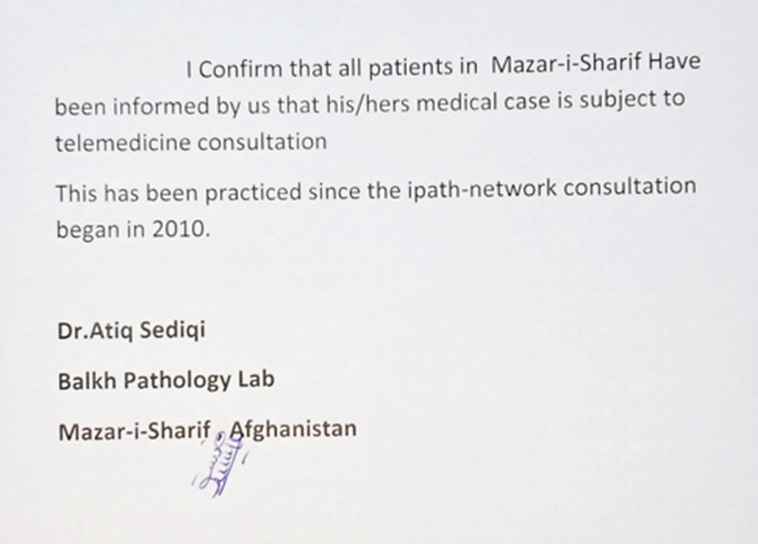
Hereby I Haroon Firooz confirm that all patients in Herat have been informed by us that his/her medical case is subject to telemedicine consultation. This information was done verbal as most patients are illiteral
This has been the practice since the ipath-Network consultation began in 2010.
Sincerely

Dr. Haroon Firooz
Authors declaration of no conflict of interest:
None of the authors declares a conflict of interest
Access to iPath.network.com: Every data scientist or scientist may have access to iPath-network. She/he needs a registration and should refer to the title of publication.
Internet: www.ipath.network.com
Data availability statement: Each reader (data scientist, physician or researcher) can have access to the data by registration to www.ipath.network.de , when pointing to the present publication. Then he can identify each research case by the iPath-network ID (first row table List of diagnosis used in the presented study in Supplement). Registration in iPath-network and Memem7 is free of charge.
Clearly Auctoresonline and particularly Psychology and Mental Health Care Journal is dedicated to improving health care services for individuals and populations. The editorial boards' ability to efficiently recognize and share the global importance of health literacy with a variety of stakeholders. Auctoresonline publishing platform can be used to facilitate of optimal client-based services and should be added to health care professionals' repertoire of evidence-based health care resources.

Journal of Clinical Cardiology and Cardiovascular Intervention The submission and review process was adequate. However I think that the publication total value should have been enlightened in early fases. Thank you for all.

Journal of Women Health Care and Issues By the present mail, I want to say thank to you and tour colleagues for facilitating my published article. Specially thank you for the peer review process, support from the editorial office. I appreciate positively the quality of your journal.

Journal of Clinical Research and Reports I would be very delighted to submit my testimonial regarding the reviewer board and the editorial office. The reviewer board were accurate and helpful regarding any modifications for my manuscript. And the editorial office were very helpful and supportive in contacting and monitoring with any update and offering help. It was my pleasure to contribute with your promising Journal and I am looking forward for more collaboration.

We would like to thank the Journal of Thoracic Disease and Cardiothoracic Surgery because of the services they provided us for our articles. The peer-review process was done in a very excellent time manner, and the opinions of the reviewers helped us to improve our manuscript further. The editorial office had an outstanding correspondence with us and guided us in many ways. During a hard time of the pandemic that is affecting every one of us tremendously, the editorial office helped us make everything easier for publishing scientific work. Hope for a more scientific relationship with your Journal.
The peer-review process which consisted high quality queries on the paper. I did answer six reviewers’ questions and comments before the paper was accepted. The support from the editorial office is excellent.

Journal of Neuroscience and Neurological Surgery. I had the experience of publishing a research article recently. The whole process was simple from submission to publication. The reviewers made specific and valuable recommendations and corrections that improved the quality of my publication. I strongly recommend this Journal.
Dr. Katarzyna Byczkowska My testimonial covering: "The peer review process is quick and effective. The support from the editorial office is very professional and friendly. Quality of the Clinical Cardiology and Cardiovascular Interventions is scientific and publishes ground-breaking research on cardiology that is useful for other professionals in the field.

Thank you most sincerely, with regard to the support you have given in relation to the reviewing process and the processing of my article entitled "Large Cell Neuroendocrine Carcinoma of The Prostate Gland: A Review and Update" for publication in your esteemed Journal, Journal of Cancer Research and Cellular Therapeutics". The editorial team has been very supportive.

Testimony of Journal of Clinical Otorhinolaryngology: work with your Reviews has been a educational and constructive experience. The editorial office were very helpful and supportive. It was a pleasure to contribute to your Journal.
Dr. Bernard Terkimbi Utoo, I am happy to publish my scientific work in Journal of Women Health Care and Issues (JWHCI). The manuscript submission was seamless and peer review process was top notch. I was amazed that 4 reviewers worked on the manuscript which made it a highly technical, standard and excellent quality paper. I appreciate the format and consideration for the APC as well as the speed of publication. It is my pleasure to continue with this scientific relationship with the esteem JWHCI.

This is an acknowledgment for peer reviewers, editorial board of Journal of Clinical Research and Reports. They show a lot of consideration for us as publishers for our research article “Evaluation of the different factors associated with side effects of COVID-19 vaccination on medical students, Mutah university, Al-Karak, Jordan”, in a very professional and easy way. This journal is one of outstanding medical journal.

Dear Hao Jiang, to Journal of Nutrition and Food Processing We greatly appreciate the efficient, professional and rapid processing of our paper by your team. If there is anything else we should do, please do not hesitate to let us know. On behalf of my co-authors, we would like to express our great appreciation to editor and reviewers.

As an author who has recently published in the journal "Brain and Neurological Disorders". I am delighted to provide a testimonial on the peer review process, editorial office support, and the overall quality of the journal. The peer review process at Brain and Neurological Disorders is rigorous and meticulous, ensuring that only high-quality, evidence-based research is published. The reviewers are experts in their fields, and their comments and suggestions were constructive and helped improve the quality of my manuscript. The review process was timely and efficient, with clear communication from the editorial office at each stage. The support from the editorial office was exceptional throughout the entire process. The editorial staff was responsive, professional, and always willing to help. They provided valuable guidance on formatting, structure, and ethical considerations, making the submission process seamless. Moreover, they kept me informed about the status of my manuscript and provided timely updates, which made the process less stressful. The journal Brain and Neurological Disorders is of the highest quality, with a strong focus on publishing cutting-edge research in the field of neurology. The articles published in this journal are well-researched, rigorously peer-reviewed, and written by experts in the field. The journal maintains high standards, ensuring that readers are provided with the most up-to-date and reliable information on brain and neurological disorders. In conclusion, I had a wonderful experience publishing in Brain and Neurological Disorders. The peer review process was thorough, the editorial office provided exceptional support, and the journal's quality is second to none. I would highly recommend this journal to any researcher working in the field of neurology and brain disorders.

Dear Agrippa Hilda, Journal of Neuroscience and Neurological Surgery, Editorial Coordinator, I trust this message finds you well. I want to extend my appreciation for considering my article for publication in your esteemed journal. I am pleased to provide a testimonial regarding the peer review process and the support received from your editorial office. The peer review process for my paper was carried out in a highly professional and thorough manner. The feedback and comments provided by the authors were constructive and very useful in improving the quality of the manuscript. This rigorous assessment process undoubtedly contributes to the high standards maintained by your journal.
International Journal of Clinical Case Reports and Reviews. I strongly recommend to consider submitting your work to this high-quality journal. The support and availability of the Editorial staff is outstanding and the review process was both efficient and rigorous.

Thank you very much for publishing my Research Article titled “Comparing Treatment Outcome Of Allergic Rhinitis Patients After Using Fluticasone Nasal Spray And Nasal Douching" in the Journal of Clinical Otorhinolaryngology. As Medical Professionals we are immensely benefited from study of various informative Articles and Papers published in this high quality Journal. I look forward to enriching my knowledge by regular study of the Journal and contribute my future work in the field of ENT through the Journal for use by the medical fraternity. The support from the Editorial office was excellent and very prompt. I also welcome the comments received from the readers of my Research Article.
Dear Erica Kelsey, Editorial Coordinator of Cancer Research and Cellular Therapeutics Our team is very satisfied with the processing of our paper by your journal. That was fast, efficient, rigorous, but without unnecessary complications. We appreciated the very short time between the submission of the paper and its publication on line on your site.

I am very glad to say that the peer review process is very successful and fast and support from the Editorial Office. Therefore, I would like to continue our scientific relationship for a long time. And I especially thank you for your kindly attention towards my article. Have a good day!

"We recently published an article entitled “Influence of beta-Cyclodextrins upon the Degradation of Carbofuran Derivatives under Alkaline Conditions" in the Journal of “Pesticides and Biofertilizers” to show that the cyclodextrins protect the carbamates increasing their half-life time in the presence of basic conditions This will be very helpful to understand carbofuran behaviour in the analytical, agro-environmental and food areas. We greatly appreciated the interaction with the editor and the editorial team; we were particularly well accompanied during the course of the revision process, since all various steps towards publication were short and without delay".

I would like to express my gratitude towards you process of article review and submission. I found this to be very fair and expedient. Your follow up has been excellent. I have many publications in national and international journal and your process has been one of the best so far. Keep up the great work.

We are grateful for this opportunity to provide a glowing recommendation to the Journal of Psychiatry and Psychotherapy. We found that the editorial team were very supportive, helpful, kept us abreast of timelines and over all very professional in nature. The peer review process was rigorous, efficient and constructive that really enhanced our article submission. The experience with this journal remains one of our best ever and we look forward to providing future submissions in the near future.

I am very pleased to serve as EBM of the journal, I hope many years of my experience in stem cells can help the journal from one way or another. As we know, stem cells hold great potential for regenerative medicine, which are mostly used to promote the repair response of diseased, dysfunctional or injured tissue using stem cells or their derivatives. I think Stem Cell Research and Therapeutics International is a great platform to publish and share the understanding towards the biology and translational or clinical application of stem cells.

I would like to give my testimony in the support I have got by the peer review process and to support the editorial office where they were of asset to support young author like me to be encouraged to publish their work in your respected journal and globalize and share knowledge across the globe. I really give my great gratitude to your journal and the peer review including the editorial office.

I am delighted to publish our manuscript entitled "A Perspective on Cocaine Induced Stroke - Its Mechanisms and Management" in the Journal of Neuroscience and Neurological Surgery. The peer review process, support from the editorial office, and quality of the journal are excellent. The manuscripts published are of high quality and of excellent scientific value. I recommend this journal very much to colleagues.

Dr.Tania Muñoz, My experience as researcher and author of a review article in The Journal Clinical Cardiology and Interventions has been very enriching and stimulating. The editorial team is excellent, performs its work with absolute responsibility and delivery. They are proactive, dynamic and receptive to all proposals. Supporting at all times the vast universe of authors who choose them as an option for publication. The team of review specialists, members of the editorial board, are brilliant professionals, with remarkable performance in medical research and scientific methodology. Together they form a frontline team that consolidates the JCCI as a magnificent option for the publication and review of high-level medical articles and broad collective interest. I am honored to be able to share my review article and open to receive all your comments.
“The peer review process of JPMHC is quick and effective. Authors are benefited by good and professional reviewers with huge experience in the field of psychology and mental health. The support from the editorial office is very professional. People to contact to are friendly and happy to help and assist any query authors might have. Quality of the Journal is scientific and publishes ground-breaking research on mental health that is useful for other professionals in the field”.

Dear editorial department: On behalf of our team, I hereby certify the reliability and superiority of the International Journal of Clinical Case Reports and Reviews in the peer review process, editorial support, and journal quality. Firstly, the peer review process of the International Journal of Clinical Case Reports and Reviews is rigorous, fair, transparent, fast, and of high quality. The editorial department invites experts from relevant fields as anonymous reviewers to review all submitted manuscripts. These experts have rich academic backgrounds and experience, and can accurately evaluate the academic quality, originality, and suitability of manuscripts. The editorial department is committed to ensuring the rigor of the peer review process, while also making every effort to ensure a fast review cycle to meet the needs of authors and the academic community. Secondly, the editorial team of the International Journal of Clinical Case Reports and Reviews is composed of a group of senior scholars and professionals with rich experience and professional knowledge in related fields. The editorial department is committed to assisting authors in improving their manuscripts, ensuring their academic accuracy, clarity, and completeness. Editors actively collaborate with authors, providing useful suggestions and feedback to promote the improvement and development of the manuscript. We believe that the support of the editorial department is one of the key factors in ensuring the quality of the journal. Finally, the International Journal of Clinical Case Reports and Reviews is renowned for its high- quality articles and strict academic standards. The editorial department is committed to publishing innovative and academically valuable research results to promote the development and progress of related fields. The International Journal of Clinical Case Reports and Reviews is reasonably priced and ensures excellent service and quality ratio, allowing authors to obtain high-level academic publishing opportunities in an affordable manner. I hereby solemnly declare that the International Journal of Clinical Case Reports and Reviews has a high level of credibility and superiority in terms of peer review process, editorial support, reasonable fees, and journal quality. Sincerely, Rui Tao.

Clinical Cardiology and Cardiovascular Interventions I testity the covering of the peer review process, support from the editorial office, and quality of the journal.

Clinical Cardiology and Cardiovascular Interventions, we deeply appreciate the interest shown in our work and its publication. It has been a true pleasure to collaborate with you. The peer review process, as well as the support provided by the editorial office, have been exceptional, and the quality of the journal is very high, which was a determining factor in our decision to publish with you.
The peer reviewers process is quick and effective, the supports from editorial office is excellent, the quality of journal is high. I would like to collabroate with Internatioanl journal of Clinical Case Reports and Reviews journal clinically in the future time.

Clinical Cardiology and Cardiovascular Interventions, I would like to express my sincerest gratitude for the trust placed in our team for the publication in your journal. It has been a true pleasure to collaborate with you on this project. I am pleased to inform you that both the peer review process and the attention from the editorial coordination have been excellent. Your team has worked with dedication and professionalism to ensure that your publication meets the highest standards of quality. We are confident that this collaboration will result in mutual success, and we are eager to see the fruits of this shared effort.

Dear Dr. Jessica Magne, Editorial Coordinator 0f Clinical Cardiology and Cardiovascular Interventions, I hope this message finds you well. I want to express my utmost gratitude for your excellent work and for the dedication and speed in the publication process of my article titled "Navigating Innovation: Qualitative Insights on Using Technology for Health Education in Acute Coronary Syndrome Patients." I am very satisfied with the peer review process, the support from the editorial office, and the quality of the journal. I hope we can maintain our scientific relationship in the long term.
Dear Monica Gissare, - Editorial Coordinator of Nutrition and Food Processing. ¨My testimony with you is truly professional, with a positive response regarding the follow-up of the article and its review, you took into account my qualities and the importance of the topic¨.
Dear Dr. Jessica Magne, Editorial Coordinator 0f Clinical Cardiology and Cardiovascular Interventions, The review process for the article “The Handling of Anti-aggregants and Anticoagulants in the Oncologic Heart Patient Submitted to Surgery” was extremely rigorous and detailed. From the initial submission to the final acceptance, the editorial team at the “Journal of Clinical Cardiology and Cardiovascular Interventions” demonstrated a high level of professionalism and dedication. The reviewers provided constructive and detailed feedback, which was essential for improving the quality of our work. Communication was always clear and efficient, ensuring that all our questions were promptly addressed. The quality of the “Journal of Clinical Cardiology and Cardiovascular Interventions” is undeniable. It is a peer-reviewed, open-access publication dedicated exclusively to disseminating high-quality research in the field of clinical cardiology and cardiovascular interventions. The journal's impact factor is currently under evaluation, and it is indexed in reputable databases, which further reinforces its credibility and relevance in the scientific field. I highly recommend this journal to researchers looking for a reputable platform to publish their studies.

Dear Editorial Coordinator of the Journal of Nutrition and Food Processing! "I would like to thank the Journal of Nutrition and Food Processing for including and publishing my article. The peer review process was very quick, movement and precise. The Editorial Board has done an extremely conscientious job with much help, valuable comments and advices. I find the journal very valuable from a professional point of view, thank you very much for allowing me to be part of it and I would like to participate in the future!”

Dealing with The Journal of Neurology and Neurological Surgery was very smooth and comprehensive. The office staff took time to address my needs and the response from editors and the office was prompt and fair. I certainly hope to publish with this journal again.Their professionalism is apparent and more than satisfactory. Susan Weiner

My Testimonial Covering as fellowing: Lin-Show Chin. The peer reviewers process is quick and effective, the supports from editorial office is excellent, the quality of journal is high. I would like to collabroate with Internatioanl journal of Clinical Case Reports and Reviews.

My experience publishing in Psychology and Mental Health Care was exceptional. The peer review process was rigorous and constructive, with reviewers providing valuable insights that helped enhance the quality of our work. The editorial team was highly supportive and responsive, making the submission process smooth and efficient. The journal's commitment to high standards and academic rigor makes it a respected platform for quality research. I am grateful for the opportunity to publish in such a reputable journal.
My experience publishing in International Journal of Clinical Case Reports and Reviews was exceptional. I Come forth to Provide a Testimonial Covering the Peer Review Process and the editorial office for the Professional and Impartial Evaluation of the Manuscript.
I would like to offer my testimony in the support. I have received through the peer review process and support the editorial office where they are to support young authors like me, encourage them to publish their work in your esteemed journals, and globalize and share knowledge globally. I really appreciate your journal, peer review, and editorial office.

Dear Agrippa Hilda- Editorial Coordinator of Journal of Neuroscience and Neurological Surgery, "The peer review process was very quick and of high quality, which can also be seen in the articles in the journal. The collaboration with the editorial office was very good."

I would like to express my sincere gratitude for the support and efficiency provided by the editorial office throughout the publication process of my article, “Delayed Vulvar Metastases from Rectal Carcinoma: A Case Report.” I greatly appreciate the assistance and guidance I received from your team, which made the entire process smooth and efficient. The peer review process was thorough and constructive, contributing to the overall quality of the final article. I am very grateful for the high level of professionalism and commitment shown by the editorial staff, and I look forward to maintaining a long-term collaboration with the International Journal of Clinical Case Reports and Reviews.

To Dear Erin Aust, I would like to express my heartfelt appreciation for the opportunity to have my work published in this esteemed journal. The entire publication process was smooth and well-organized, and I am extremely satisfied with the final result. The Editorial Team demonstrated the utmost professionalism, providing prompt and insightful feedback throughout the review process. Their clear communication and constructive suggestions were invaluable in enhancing my manuscript, and their meticulous attention to detail and dedication to quality are truly commendable. Additionally, the support from the Editorial Office was exceptional. From the initial submission to the final publication, I was guided through every step of the process with great care and professionalism. The team's responsiveness and assistance made the entire experience both easy and stress-free. I am also deeply impressed by the quality and reputation of the journal. It is an honor to have my research featured in such a respected publication, and I am confident that it will make a meaningful contribution to the field.

"I am grateful for the opportunity of contributing to [International Journal of Clinical Case Reports and Reviews] and for the rigorous review process that enhances the quality of research published in your esteemed journal. I sincerely appreciate the time and effort of your team who have dedicatedly helped me in improvising changes and modifying my manuscript. The insightful comments and constructive feedback provided have been invaluable in refining and strengthening my work".
I thank the ‘Journal of Clinical Research and Reports’ for accepting this article for publication. This is a rigorously peer reviewed journal which is on all major global scientific data bases. I note the review process was prompt, thorough and professionally critical. It gave us an insight into a number of important scientific/statistical issues. The review prompted us to review the relevant literature again and look at the limitations of the study. The peer reviewers were open, clear in the instructions and the editorial team was very prompt in their communication. This journal certainly publishes quality research articles. I would recommend the journal for any future publications.

Dear Jessica Magne, with gratitude for the joint work. Fast process of receiving and processing the submitted scientific materials in “Clinical Cardiology and Cardiovascular Interventions”. High level of competence of the editors with clear and correct recommendations and ideas for enriching the article.
We found the peer review process quick and positive in its input. The support from the editorial officer has been very agile, always with the intention of improving the article and taking into account our subsequent corrections.
My article, titled 'No Way Out of the Smartphone Epidemic Without Considering the Insights of Brain Research,' has been republished in the International Journal of Clinical Case Reports and Reviews. The review process was seamless and professional, with the editors being both friendly and supportive. I am deeply grateful for their efforts.

To Dear Erin Aust – Editorial Coordinator of Journal of General Medicine and Clinical Practice! I declare that I am absolutely satisfied with your work carried out with great competence in following the manuscript during the various stages from its receipt, during the revision process to the final acceptance for publication. Thank Prof. Elvira Farina
Dear Jessica, and the super professional team of the ‘Clinical Cardiology and Cardiovascular Interventions’ I am sincerely grateful to the coordinated work of the journal team for the no problem with the submission of my manuscript: “Cardiometabolic Disorders in A Pregnant Woman with Severe Preeclampsia on the Background of Morbid Obesity (Case Report).” The review process by 5 experts was fast, and the comments were professional, which made it more specific and academic, and the process of publication and presentation of the article was excellent. I recommend that my colleagues publish articles in this journal, and I am interested in further scientific cooperation. Sincerely and best wishes, Dr. Oleg Golyanovskiy.

Dear Ashley Rosa, Editorial Coordinator of the journal - Psychology and Mental Health Care. " The process of obtaining publication of my article in the Psychology and Mental Health Journal was positive in all areas. The peer review process resulted in a number of valuable comments, the editorial process was collaborative and timely, and the quality of this journal has been quickly noticed, resulting in alternative journals contacting me to publish with them." Warm regards, Susan Anne Smith, PhD. Australian Breastfeeding Association.
Dear Jessica Magne, Editorial Coordinator, Clinical Cardiology and Cardiovascular Interventions, Auctores Publishing LLC. I appreciate the journal (JCCI) editorial office support, the entire team leads were always ready to help, not only on technical front but also on thorough process. Also, I should thank dear reviewers’ attention to detail and creative approach to teach me and bring new insights by their comments. Surely, more discussions and introduction of other hemodynamic devices would provide better prevention and management of shock states. Your efforts and dedication in presenting educational materials in this journal are commendable. Best wishes from, Farahnaz Fallahian.

Dear Maria Emerson, Editorial Coordinator, International Journal of Clinical Case Reports and Reviews, Auctores Publishing LLC. I am delighted to have published our manuscript, "Acute Colonic Pseudo-Obstruction (ACPO): A rare but serious complication following caesarean section." I want to thank the editorial team, especially Maria Emerson, for their prompt review of the manuscript, quick responses to queries, and overall support. Yours sincerely Dr. Victor Olagundoye.
Dear Ashley Rosa, Editorial Coordinator, International Journal of Clinical Case Reports and Reviews. Many thanks for publishing this manuscript after I lost confidence the editors were most helpful, more than other journals Best wishes from, Susan Anne Smith, PhD. Australian Breastfeeding Association.
Dear Agrippa Hilda, Editorial Coordinator, Journal of Neuroscience and Neurological Surgery. The entire process including article submission, review, revision, and publication was extremely easy. The journal editor was prompt and helpful, and the reviewers contributed to the quality of the paper. Thank you so much! Eric Nussbaum, MD

Dr Hala Al Shaikh This is to acknowledge that the peer review process for the article ’ A Novel Gnrh1 Gene Mutation in Four Omani Male Siblings, Presentation and Management ’ sent to the International Journal of Clinical Case Reports and Reviews was quick and smooth. The editorial office was prompt with easy communication.
Dear Erin Aust, Editorial Coordinator, Journal of General Medicine and Clinical Practice. We are pleased to share our experience with the “Journal of General Medicine and Clinical Practice”, following the successful publication of our article. The peer review process was thorough and constructive, helping to improve the clarity and quality of the manuscript. We are especially thankful to Ms. Erin Aust, the Editorial Coordinator, for her prompt communication and continuous support throughout the process. Her professionalism ensured a smooth and efficient publication experience. The journal upholds high editorial standards, and we highly recommend it to fellow researchers seeking a credible platform for their work. Best wishes By, Dr. Rakhi Mishra.

Dear Jessica Magne, Editorial Coordinator, Clinical Cardiology and Cardiovascular Interventions, Auctores Publishing LLC. The peer review process of the journal of Clinical Cardiology and Cardiovascular Interventions was excellent and fast, as was the support of the editorial office and the quality of the journal. Kind regards Walter F. Riesen Prof. Dr. Dr. h.c. Walter F. Riesen.

Dear Ashley Rosa, Editorial Coordinator, International Journal of Clinical Case Reports and Reviews, Auctores Publishing LLC. Thank you for publishing our article, Exploring Clozapine's Efficacy in Managing Aggression: A Multiple Single-Case Study in Forensic Psychiatry in the international journal of clinical case reports and reviews. We found the peer review process very professional and efficient. The comments were constructive, and the whole process was efficient. On behalf of the co-authors, I would like to thank you for publishing this article. With regards, Dr. Jelle R. Lettinga.

Dear Clarissa Eric, Editorial Coordinator, Journal of Clinical Case Reports and Studies, I would like to express my deep admiration for the exceptional professionalism demonstrated by your journal. I am thoroughly impressed by the speed of the editorial process, the substantive and insightful reviews, and the meticulous preparation of the manuscript for publication. Additionally, I greatly appreciate the courteous and immediate responses from your editorial office to all my inquiries. Best Regards, Dariusz Ziora

Dear Chrystine Mejia, Editorial Coordinator, Journal of Neurodegeneration and Neurorehabilitation, Auctores Publishing LLC, We would like to thank the editorial team for the smooth and high-quality communication leading up to the publication of our article in the Journal of Neurodegeneration and Neurorehabilitation. The reviewers have extensive knowledge in the field, and their relevant questions helped to add value to our publication. Kind regards, Dr. Ravi Shrivastava.

Dear Clarissa Eric, Editorial Coordinator, Journal of Clinical Case Reports and Studies, Auctores Publishing LLC, USA Office: +1-(302)-520-2644. I would like to express my sincere appreciation for the efficient and professional handling of my case report by the ‘Journal of Clinical Case Reports and Studies’. The peer review process was not only fast but also highly constructive—the reviewers’ comments were clear, relevant, and greatly helped me improve the quality and clarity of my manuscript. I also received excellent support from the editorial office throughout the process. Communication was smooth and timely, and I felt well guided at every stage, from submission to publication. The overall quality and rigor of the journal are truly commendable. I am pleased to have published my work with Journal of Clinical Case Reports and Studies, and I look forward to future opportunities for collaboration. Sincerely, Aline Tollet, UCLouvain.

Dear Ms. Mayra Duenas, Editorial Coordinator, International Journal of Clinical Case Reports and Reviews. “The International Journal of Clinical Case Reports and Reviews represented the “ideal house” to share with the research community a first experience with the use of the Simeox device for speech rehabilitation. High scientific reputation and attractive website communication were first determinants for the selection of this Journal, and the following submission process exceeded expectations: fast but highly professional peer review, great support by the editorial office, elegant graphic layout. Exactly what a dynamic research team - also composed by allied professionals - needs!" From, Chiara Beccaluva, PT - Italy.
Dear Maria Emerson, Editorial Coordinator, we have deeply appreciated the professionalism demonstrated by the International Journal of Clinical Case Reports and Reviews. The reviewers have extensive knowledge of our field and have been very efficient and fast in supporting the process. I am really looking forward to further collaboration. Thanks. Best regards, Dr. Claudio Ligresti

Dear Chrystine Mejia, Editorial Coordinator, Journal of Neurodegeneration and Neurorehabilitation. “The peer review process was efficient and constructive, and the editorial office provided excellent communication and support throughout. The journal ensures scientific rigor and high editorial standards, while also offering a smooth and timely publication process. We sincerely appreciate the work of the editorial team in facilitating the dissemination of innovative approaches such as the Bonori Method.” Best regards, Dr. Matteo Bonori.

I recommend without hesitation submitting relevant papers on medical decision making to the International Journal of Clinical Case Reports and Reviews. I am very grateful to the editorial staff. Maria Emerson was a pleasure to communicate with. The time from submission to publication was an extremely short 3 weeks. The editorial staff submitted the paper to three reviewers. Two of the reviewers commented positively on the value of publishing the paper. The editorial staff quickly recognized the third reviewer’s comments as an unjust attempt to reject the paper. I revised the paper as recommended by the first two reviewers.

Dear Maria Emerson, Editorial Coordinator, Journal of Clinical Research and Reports. Thank you for publishing our case report: "Clinical Case of Effective Fetal Stem Cells Treatment in a Patient with Autism Spectrum Disorder" within the "Journal of Clinical Research and Reports" being submitted by the team of EmCell doctors from Kyiv, Ukraine. We much appreciate a professional and transparent peer-review process from Auctores. All research Doctors are so grateful to your Editorial Office and Auctores Publishing support! I amiably wish our article publication maintained a top quality of your International Scientific Journal. My best wishes for a prosperity of the Journal of Clinical Research and Reports. Hope our scientific relationship and cooperation will remain long lasting. Thank you very much indeed. Kind regards, Dr. Andriy Sinelnyk Cell Therapy Center EmCell

Dear Editorial Team, Clinical Cardiology and Cardiovascular Interventions. It was truly a rewarding experience to work with the journal “Clinical Cardiology and Cardiovascular Interventions”. The peer review process was insightful and encouraging, helping us refine our work to a higher standard. The editorial office offered exceptional support with prompt and thoughtful communication. I highly value the journal’s role in promoting scientific advancement and am honored to be part of it. Best regards, Meng-Jou Lee, MD, Department of Anesthesiology, National Taiwan University Hospital.
Dear Editorial Team, Journal-Clinical Cardiology and Cardiovascular Interventions, “Publishing my article with Clinical Cardiology and Cardiovascular Interventions has been a highly positive experience. The peer-review process was rigorous yet supportive, offering valuable feedback that strengthened my work. The editorial team demonstrated exceptional professionalism, prompt communication, and a genuine commitment to maintaining the highest scientific standards. I am very pleased with the publication quality and proud to be associated with such a reputable journal.” Warm regards, Dr. Mahmoud Kamal Moustafa Ahmed

Dear Maria Emerson, Editorial Coordinator of ‘International Journal of Clinical Case Reports and Reviews’, I appreciate the opportunity to publish my article with your journal. The editorial office provided clear communication during the submission and review process, and I found the overall experience professional and constructive. Best regards, Elena Salvatore.

Dear Mayra Duenas, Editorial Coordinator of ‘International Journal of Clinical Case Reports and Reviews Herewith I confirm an optimal peer review process and a great support of the editorial office of the present journal

Dear Editorial Team, Clinical Cardiology and Cardiovascular Interventions. I am really grateful for the peers review; their feedback gave me the opportunity to reflect on the message and impact of my work and to ameliorate the article. The editors did a great job in addition by encouraging me to continue with the process of publishing.

Dear Cecilia Lilly, Editorial Coordinator, Endocrinology and Disorders, Thank you so much for your quick response regarding reviewing and all process till publishing our manuscript entitled: Prevalence of Pre-Diabetes and its Associated Risk Factors Among Nile College Students, Sudan. Best regards, Dr Mamoun Magzoub.

International Journal of Clinical Case Reports and Reviews is a high quality journal that has a clear and concise submission process. The peer review process was comprehensive and constructive. Support from the editorial office was excellent, since the administrative staff were responsive. The journal provides a fast and timely publication timeline.
Dear Maria Emerson, Editorial Coordinator of International Journal of Clinical Case Reports and Reviews, What distinguishes International Journal of Clinical Case Report and Review is not only the scientific rigor of its publications, but the intellectual climate in which research is evaluated. The submission process is refreshingly free of unnecessary formal barriers and bureaucratic rituals that often complicate academic publishing without adding real value. The peer-review system is demanding yet constructive, guided by genuine scientific dialogue rather than hierarchical or authoritarian attitudes. Reviewers act as collaborators in improving the manuscript, not as gatekeepers imposing arbitrary standards. This journal offers a rare balance: high methodological standards combined with a respectful, transparent, and supportive editorial approach. In an era where publishing can feel more burdensome than research itself, this platform restores the original purpose of peer review — to refine ideas, not to obstruct them Prof. Perlat Kapisyzi, FCCP PULMONOLOGIST AND THORACIC IMAGING.

Dear Grace Pierce, International Journal of Clinical Case Reports and Reviews I appreciate the opportunity to review for Auctore Journal, as the overall editorial process was smooth, transparent and professionally managed. This journal maintains high scientific standards and ensures timely communications with authors, which is truly commendable. I would like to express my special thanks to editor Grace Pierce for his constant guidance, promt responses, and supportive coordination throughout the review process. I am also greatful to Eleanor Bailey from the finance department for her clear communication and efficient handling of all administrative matters. Overall, my experience with Auctore Journal has been highly positive and rewarding. Best regards, Sabita sinha
Dear Mayra Duenas, Editorial Coordinator of the journal IJCCR, I write here a little on my experience as an author submitting to the International Journal of Clinical Case Reports and Reviews (IJCCR). This was my first submission to IJCCR and my manuscript was inherently an outsider’s effort. It attempted to broadly identify and then make some sense of life’s under-appreciated mysteries. I initially had responded to a request for possible submissions. I then contacted IJCCR with a tentative topic for a manuscript. They quickly got back with an approval for the submission, but with a particular requirement that it be medically relevant. I then put together a manuscript and submitted it. After the usual back-and-forth over forms and formality, the manuscript was sent off for reviews. Within 2 weeks I got back 4 reviews which were both helpful and also surprising. Surprising in that the topic was somewhat foreign to medical literature. My subsequent updates in response to the reviewer comments went smoothly and in short order I had a series of proofs to evaluate. All in all, the whole publication process seemed outstanding. It was both helpful in terms of the paper’s content and also in terms of its efficient and friendly communications. Thank you all very much. Sincerely, Ted Christopher, Rochester, NY.