Case Report | DOI: https://doi.org/10.31579/JHV-2021/020
*Corresponding Author: Massimo Bolognesi, Centre for Sports Cardiology, Via Ungaretti 494 47521, Cesena (FC) Italy.
Citation: Bolognesi M. (2021) Inducible atrial fibrillation and myocardial ischemia in a veteran amateur runner: an anecdotal case report. J, Heart and Vasculature 1(5); DOI: 10.31579/JHV-2021/020
Copyright: © 2021, Massimo Bolognesi, This is an open access article distributed under the Creative Commons Attribution License, which permits unrestricted use, distribution, and reproduction in any medium, provided the original work is properly cited.
Received: 21 May 2021 | Accepted: 17 July 2021 | Published: 20 August 2021
Keywords: atrial fibrillation, coronary artery disease, veteran athletes, ex-ECG stress testing
Atrial fibrillation is the most common sustained cardiac arrhythmia and is associated with significant morbidity and mortality. Coronary artery disease frequently coexists with AF, and management of these associated conditions can be challenging. Endurance veteran athletes are a population at high risk to have episodes of paroxysmal atrial fibrillation. Herewith the author describes an original case of induced atrial fibrillation and myocardial ischemia during an Ex-ECG stress test in a veteran amateur runner.
AF is a dangerous arrhythmia because it is associated with significantly impaired quality of life and exercise capacity, a five-fold increase in the risk of thromboembolic stroke, and a two-fold increase in overall mortality [1]. Environmental factors and state pathologies increase the risk of developing AF, including hypertension, heart failure, valvular heart disease, obesity, diabetes mellitus, and thyroid disease. Most of these risk factors are associated with coronary artery disease (CAD), and clinically relevant concomitant CAD is present in 26-36% of patients with AF [2]. The population with coronary artery disease (CAD), even silent coronary artery disease that suddenly has episodes of paroxysmal atrial fibrillation, is growing [3]. A strong correlation between the two conditions has been known, and the many common risk factors they share may play an essential role in their development. In addition, CAD may directly promote the onset and progression of AF by influencing re-entry formation, focal ectopic activity, and neural remodeling.4 Indeed, AF is often an epiphenomenon of CAD that develops because of the following mechanisms and aspects: 1) atherosclerosis, 2) mismatch between blood supply and oxygen consumption, and finally 3) thrombosis. Coronary artery disease may have a unique clinical presentation through the appearance solely of paroxysmal atrial fibrillation induced by physical activity in the absence of the classic signs of angina pectoris or equivalent symptoms.5 Herewith, the author wants to present a singular case of a veteran amateur runner who came to our sports cardiology center because he found unexplained alterations in heart rate during physical activity detected at the heart rate monitor. He did not report other symptoms like chest pain or tachycardia, but only a slight decline in his fitness.
A 72-year-old male veteran amateur runner in apparent good health presented to our Center of Sports Cardiology for a medical checkup. He reported that his heart rate monitor detected sudden increases in heart rate during a regular, non-demanding running pace while also complaining of a general sense of fatigue. The athlete had previous medical examinations carried out for the eligibility to practice competitive athletics. He was taking antihypertensive drugs, including nebivolol, to control a form of uncomplicated arterial hypertension. The objective examination was regular, and so was the resting electrocardiogram (Figure 1). Then, the athlete proceeded to the cycle-ergometer exercise stress test. During the stress test, at the second step corresponding to 100 watts of external load, atrial fibrillation with high ventricular response started (Figure 2), which continued for over 20 minutes after stopping the stress test. The ECG showed clear signs of ventricular repolarization abnormalities, i.e. ST-segment depression by more than 2 mm with a horizontal and descending pattern on the inferior and precordial leads from V3 to V6. The athlete remained in an upright sitting position, hemodynamic stable (normal blood pressure) without chest pain or tachycardia symptoms. The athlete assumed 165 mg acetylsalicylic acid and 20 drops of Diazepam. After that, the athlete was accompanied in stable conditions walking autonomously to the emergency department for monitoring and cardiac examination. At the ED, the ECG resulted in the normal range, restoring normal sinus rhythm. The consultant cardiologist recommended only therapy with bisoprolol 2.5 mg (bis in die) plus Ramipril 5 mg per day and Xarelto 150 mg (bis in die). He also planned echo stress after a few months and suggested a consultation for transcatheter catheter ablation. However, the athlete moved on to the cath lab for coronary angiography, as we were sure of the coexistence of a critical multi-vessel coronary artery disease. Indeed, the coronary angiography showed a multi-vessel CAD treated first with angioplasty for Ostial D1 significant stenosis. Also, the athlete underwent angioplasty plus DES implantation for the obstruction of the proximal CX coronary artery. Only moderate stenosis on the mid-IVA plus critical distal stenosis did not have any revascularization procedure. The athlete remained in good condition.


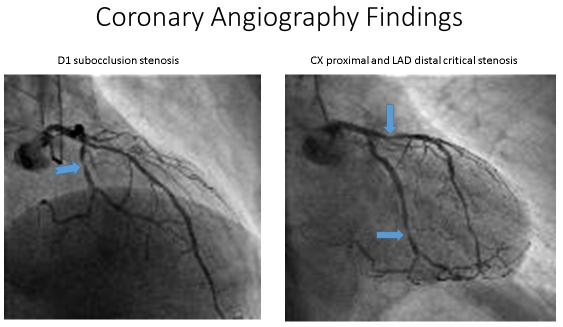
Atrial fibrillation is the most frequent arrhythmia in the general population and Master and veteran athletes, to the extent that its incidence has increased 4-5 times in recent years [3]. Considering the multiple cardiovascular risk factors, there is a risk of having AF among patients over 55 [6]. In parallel, many of thesesubjects are more likely to have subclinical coronary artery disease [4]. Although a 43 series of studies have extensively demonstrated the objective relationship between CAD and AF. The underlying mechanisms are not fully understood. Indeed, common risk factors for CAD and AF can provide enough elements to connect the two diseases. This case report is symbolic and significant because it offers many exciting teaching points for young doctors and practicing sports cardiology. The learning points concern the following aspects:
Of note, this case report sheds light on the strategies to break the cycle of the two diseases, which may be fundamental to treat these patients and optimize the benefits.
I certify that there is no actual or potential conflict of interest concerning this article.
Dear Editorial Team, Clinical Medical Reviews and Reports. My experience with the journal was highly positive. The peer-review process was rigorous, constructive, and completed in a timely manner. The reviewers provided valuable comments that helped improve the quality and clarity of our manuscript. The editorial office was professional, responsive, and supportive throughout all stages of the publication process. Communication was clear and efficient, and any questions were addressed promptly. Overall, I found the journal to maintain high scientific standards and an excellent publication workflow. I would be pleased to consider submitting future work to this journal. Best wishes from, Elena Popa.

It was my pleasure to submit my testimonial concerning the Reviewer Board of our Scientific Journal “Brain and Neurological Disorders”. The Reviewers focused on some modifications and their contribution was helpful. The ladies of our Editorial Office were also supported my efforts. It was my honor to have such a co-operation and I am looking forward for more collaboration.

Dear Grace Pierce, Editorial Coordinator of Journal of Clinical Research and Reports, Thank you for the speedy and efficient peer review process. I appreciate the fact that your peer reviewers do not take months to respond like with some other journals. I would also like to thank the editorial office for responding quickly to my questions. It is an excellent journal. I plan to submit more manuscripts in the future. Best wishes from, Robert W. McGee

Dear Grace Pierce, Editorial Coordinator of Journal of Clinical Research and Reports, Working with you and your team on our recent publication in JCRR has been a truly wonderful and enjoyable experience. The responses were prompt, and the reviewers were patient, constructive, and highly professional. One reviewer in particular gave me the feeling that a professor was carefully reading and commenting on my coursework, which was deeply touching. The entire process was straightforward and hassle‑free, with no tedious online forms to complete. I highly recommend this journal. Best wishes from, DR Aibing Rao, Head of R&D

I Appreciate the Opportunity to Share my Experience with the Journal of Clinical Research and Reports. The peer review process was timely and constructive, and the feedback provided helped improve the quality of our manuscript. The editorial office was professional, responsive, and supportive throughout the process, ensuring smooth communication and efficient handling of the submission. Overall, it was a positive experience collaborating with your team.

Dear Mercy Grace, Editorial Coordinator of Obstetrics Gynecology and Reproductive Sciences, We would like to express our gratitude for your help at all stages of publishing and editing the article. The editors of the magazine answer all the necessary questions and help at every stage. We will definitely continue to cooperate and publish other works in the Obstetrics Gynecology and Reproductive Sciences! Best wishes from, Alla Konstantinovna Politova,