Editorial Article | DOI: https://doi.org/10.31579/2690-4861/1086
Department of General Surgery, Aberdeen Royal Infirmary, United Kingdom.
*Corresponding Author: Ross Hunter., Department of General Surgery, Aberdeen Royal Infirmary, United Kingdom.
Citation: Ross Hunter, (2026), Bilateral Hand Function 35 Years after 8-Digit Amputation: A Case Study, International Journal of Clinical Case Reports and Reviews, 35(3); DOI:10.31579/2690-4861/1086
Copyright: © 2026, Ross Hunter. This is an open-access article distributed under the terms of the Creative Commons Attribution License, which permits unrestricted use, distribution, and reproduction in any medium, provided the original author and source are credited.
Received: 30 March 2026 | Accepted: 10 April 2026 | Published: 27 April 2026
Keywords:
Worldwide estimate is that 10 million people are currently living with either upper or lower limb amputation. 30% of these people suffer from upper limb amputation, with the traumatic ethology of upper arm amputation making it rarer than its lower limb counterpart, in which vascular disease is the most populous causative ethology [1] and in which field most currently literature exists. An estimated 3 million people worldwide currently live with upper limb amputations [2]. While these patients can suffer from significant functional impairment and loss of locomotion, these amputations have generated a market for prosthetics and orthotics, with an estimated market value of over 12 billion US dollars by the year 2025 [3]. Progress in the field is rampant, largely driven in the US by traumatic injuries sustain by young soldiers suffering traumatic amputation in war zones, for whom return to near-full functionality is imperative [4]. For decades the use of hand prothesis focused predominantly on the aesthetics of reconstructing the shape of the human hands, with functionality a secondary goal [5]. However, over the last two decades near constant innovation has started to shift this balance and drives a growing market; Asynchronously Coded Electronic Skin (ACES) allows for tactile sensation more specific and sensitive than human skin [6]; Targeted Muscle Reinnervation (TMR) allows for active instinctual control of the prosthesis via muscles re-innervated by transected nerves [7] while the use of virtual reality systems to train patients in the use of their prosthesis has significantly reduced rehabilitation times [8]. Despite these advancements it is important to note also is the rate at which suffers of upper limb amputation abandon their prosthesis, with the rate nearing 30%, with preimplantation offering far higher rates of patient satisfaction than even advanced prosthetic use [9]. The production of hand prosthesis designed to given aesthetic satisfactory rather than function ability is reflected in the literature, with the day-to-day use of prosthetics far lower in those suffering from upper limb amputation than those with lower limb amputation [10]. Hand prosthetic wearers are mostly likely to wear their prosthesis for social activities or at work, with the association between the percentage of time the prosthesis is worn and the satisfaction with the functional capabilities of the prosthesis very low, with patients who wear their prosthesis often no more satisfied with their functional ability than those who sparsely use the prosthesis [11]. We review the case in clinic of a 71-year-old gentleman who suffered bilateral finger amputation having suffered an injury with heavy machinery while at work in February of 1986 (Figure 1). While working in a wooden mill cleaning machinery his left hand became entrapped on the cog wheels, in attempt to stop this with his right hand the result with bilateral traumatic amputation of all digits with the exception of both thumbs.
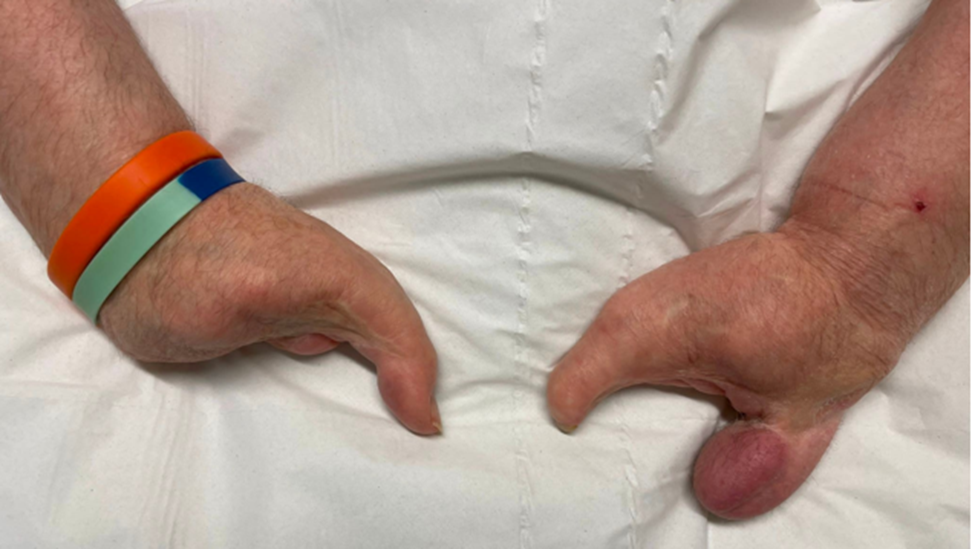
Figure 1
Different treatment options were utilised for each hand. While the right hand was treated with the creation of a bespoke prothetic hand grip (with leather on 1 side and rubber in the other) the left hand was treated with the creation of a stump at the hypothenar eminence, with bone grafted from the shaft of the radius used in this creation. In keeping with the published literature, this was a prosthesis which was made with the primary function of aesthetic (Figure 2), although it has allowed the patient to carry out a high level of function through the 35 years since his injury.
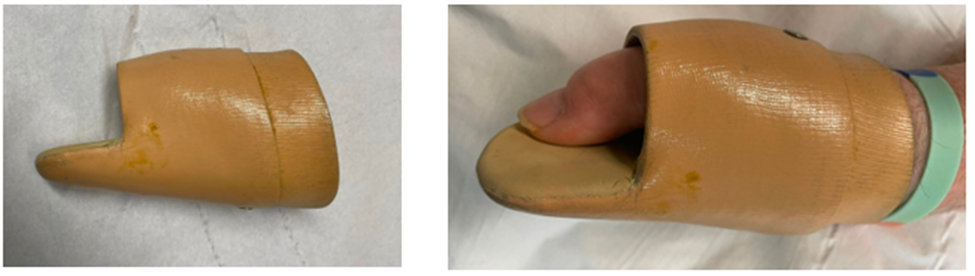
Figure 2
Following a 13 week stay in Aberdeen Royal Infirmary following the accident the patient managed to return to employment, managing to work for a further 20 years in a gardening centre, before eventually being forced into early retirement when his mobility decreased secondary to osteoarthritis. He remains living independently at home, using both hands to eat, write and perform fine motor skills including handling garden tools, turning keys and opening door handles.
Dear Editorial Team, Clinical Medical Reviews and Reports. My experience with the journal was highly positive. The peer-review process was rigorous, constructive, and completed in a timely manner. The reviewers provided valuable comments that helped improve the quality and clarity of our manuscript. The editorial office was professional, responsive, and supportive throughout all stages of the publication process. Communication was clear and efficient, and any questions were addressed promptly. Overall, I found the journal to maintain high scientific standards and an excellent publication workflow. I would be pleased to consider submitting future work to this journal. Best wishes from, Elena Popa.

It was my pleasure to submit my testimonial concerning the Reviewer Board of our Scientific Journal “Brain and Neurological Disorders”. The Reviewers focused on some modifications and their contribution was helpful. The ladies of our Editorial Office were also supported my efforts. It was my honor to have such a co-operation and I am looking forward for more collaboration.
Dear Grace Pierce, Editorial Coordinator of Journal of Clinical Research and Reports, Thank you for the speedy and efficient peer review process. I appreciate the fact that your peer reviewers do not take months to respond like with some other journals. I would also like to thank the editorial office for responding quickly to my questions. It is an excellent journal. I plan to submit more manuscripts in the future. Best wishes from, Robert W. McGee

Dear Grace Pierce, Editorial Coordinator of Journal of Clinical Research and Reports, Working with you and your team on our recent publication in JCRR has been a truly wonderful and enjoyable experience. The responses were prompt, and the reviewers were patient, constructive, and highly professional. One reviewer in particular gave me the feeling that a professor was carefully reading and commenting on my coursework, which was deeply touching. The entire process was straightforward and hassle‑free, with no tedious online forms to complete. I highly recommend this journal. Best wishes from, DR Aibing Rao, Head of R&D

I Appreciate the Opportunity to Share my Experience with the Journal of Clinical Research and Reports. The peer review process was timely and constructive, and the feedback provided helped improve the quality of our manuscript. The editorial office was professional, responsive, and supportive throughout the process, ensuring smooth communication and efficient handling of the submission. Overall, it was a positive experience collaborating with your team.

Dear Mercy Grace, Editorial Coordinator of Obstetrics Gynecology and Reproductive Sciences, We would like to express our gratitude for your help at all stages of publishing and editing the article. The editors of the magazine answer all the necessary questions and help at every stage. We will definitely continue to cooperate and publish other works in the Obstetrics Gynecology and Reproductive Sciences! Best wishes from, Alla Konstantinovna Politova,